
Mains Corner
Young Nation, Ageing Fast: India's Silent Care Crisis
GS mapping: GS-1 (Population, Role of women, Social empowerment) | GS-2 (Welfare of vulnerable sections) | GS-3 (Inclusive growth, Employment) | Essay
Why in news: The world observed the International Day of Care and Support on 29 October. The UN created the day in 2023 to recognise care work, both paid and unpaid.
The paradox nobody talks about
India is the youngest large nation in the world. Policy debates speak of the demographic dividend: a large working-age population that can power growth.
But a quieter change is under way. India is also ageing faster than ever. The same fall in fertility that creates the dividend today will create a large elderly population tomorrow.
- The dividend is a window, not a permanent gift. It closes as the workforce ages.
- Rich countries grew wealthy before they grew old. India risks growing old before growing rich.
- The real question is not "young or old". It is who will care for the old, and at what cost.
India's ageing story
India's elderly (60+) population is growing much faster than its total population. Better healthcare has raised life expectancy. Families are having fewer children.
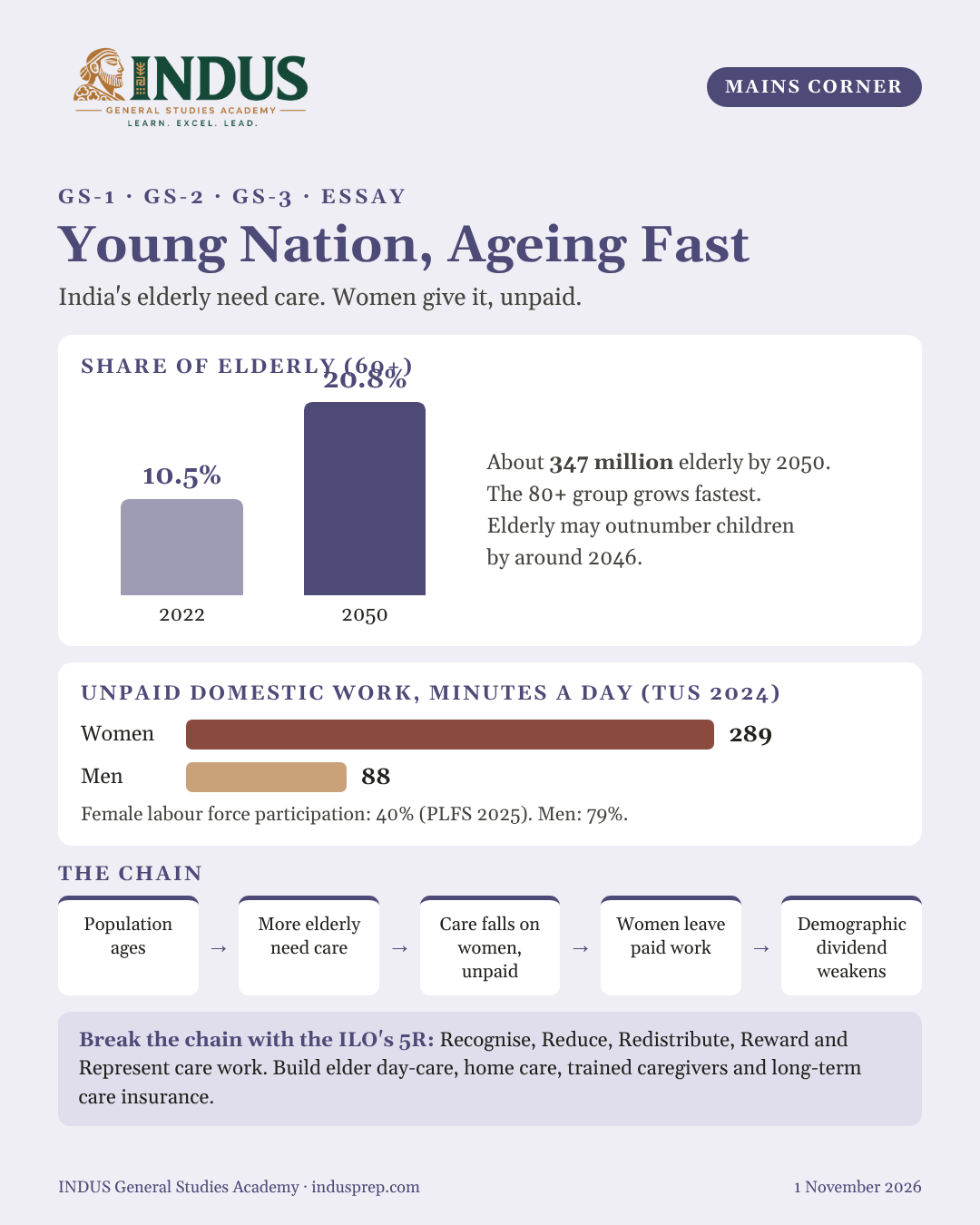
- Share of elderly: 10.5% in 2022, projected to reach 20.8% by 2050 (India Ageing Report 2023).
- Absolute number: about 347 million elderly by 2050.
- Growth gap (2022 to 2050): total population +18%, elderly +134%, the 80+ group +279%.
- Elderly may outnumber children (0 to 14 years) by around 2046.
- Fertility: India's Total Fertility Rate is 2.0 (NFHS-5), below the replacement level of 2.1.
Two Indias
Ageing is not uniform. India has a "young North" and an "old South".
- Kerala and Tamil Nadu are projected to cross 20% elderly by 2036.
- Himachal Pradesh and Punjab are already above the national average.
- Bihar and Uttar Pradesh will stay younger than the national average even in 2036.
Three features that make India's ageing different
- Feminisation of ageing: women live longer, so the elderly are increasingly women. Many are widows with little income or property.
- Ruralisation: about 71% of the elderly live in rural areas, far from good hospitals.
- Rise of the oldest-old: the 80+ group grows fastest. They need the most care.
Why it matters
Ageing is not a problem in itself. It becomes a problem when a country is unprepared. India faces six clear risks.
1. A health burden the system is not built for
Old age brings long-term illness. India's health system is designed mostly for short, acute illness and for mothers and children, not for chronic, lifelong care.
- About 75% of the elderly have one or more chronic diseases (LASI Wave 1).
- About 40% have some disability. About 20% have mental health issues.
- Geriatric care is scarce. Few doctors and nurses are trained in it, and most of it sits in cities.
- Result: high out-of-pocket spending that can push families into poverty.
2. Old age without income
Most Indians work in the informal sector. They have no pension when they stop working.
- Elderly people without savings depend on their children or on small welfare pensions.
- The central share of the old-age pension under NSAP is only ₹200 to ₹500 a month.
- Result: financial dependence, loss of dignity and poverty in old age, especially for widows.
3. The family can no longer carry the load alone
Indian society expected children to care for parents. That model is weakening.
- Nuclear families and smaller families mean fewer caregivers.
- Migration of young people to cities and abroad leaves parents behind, especially in rural areas.
- About one in five elderly live alone or only with a spouse.
- Result: loneliness, neglect and, in some cases, elder abuse.
4. The hidden cost falls on women
When an elderly person needs care, a woman in the family usually gives it. This work is unpaid and invisible.
- Daughters and daughters-in-law reduce paid work or leave jobs to care for elders.
- Many women become the "sandwich generation", caring for children and parents at the same time.
- Result: lower female workforce participation, lost income and poorer health for women caregivers.
5. Pressure on public finances
As the elderly share rises, spending on pensions, health and welfare rises too. The working-age population that pays taxes grows more slowly.
- The old-age dependency ratio rises: fewer workers support each elderly person.
- Result: less fiscal space for education, infrastructure and other priorities.
6. A weaker demographic dividend
This is the link most people miss. If women leave work to give unpaid care, India loses a large part of its potential workforce.
- Result: the demographic dividend shrinks just when India needs it most.
Is India ready?
India has laws, schemes and some good State models. But the effort is fragmented, and there is no system for long-term care.
Constitutional and legal framework
- Article 41 (DPSP): public assistance in old age, sickness and disablement.
- Maintenance and Welfare of Parents and Senior Citizens Act, 2007: children must maintain parents; Maintenance Tribunals; abandonment is an offence.
- National Policy on Older Persons, 1999.
Central government programmes
- Indira Gandhi National Old Age Pension Scheme (NSAP).
- Atal Vayo Abhyuday Yojana (AVYAY): umbrella scheme for senior citizens (Ministry of Social Justice and Empowerment).
- Rashtriya Vayoshri Yojana: free assistive devices for poor elderly.
- National Programme for Health Care of the Elderly (NPHCE).
- Ayushman Vay Vandana: ₹5 lakh health cover for all citizens aged 70+.
- Elderline (14567): national helpline for senior citizens.
- SACRED portal: jobs for senior citizens who want to work.
- SAGE: support for startups in elder care.
- LASI: India's largest survey on ageing, run by IIPS Mumbai.
State initiatives
- Kerala: among the oldest States, with community-based elder care and palliative care networks.
- Andhra Pradesh: NTR Bharosa pensions of ₹4,000 a month for the elderly.
- Telangana: Cheyutha pensions for the elderly and other vulnerable groups.
Civil society and private sector
- HelpAge India and other NGOs run mobile healthcare, helplines and old-age homes.
- A growing "silver economy" offers home care, assisted living and elder-care technology, mostly in cities.
Global frameworks
- Madrid International Plan of Action on Ageing (2002).
- UN Decade of Healthy Ageing (2021 to 2030).
- Japan's Long-Term Care Insurance (2000): a model of public, insurance-based elder care.
The verdict
- Pensions are too small to live on.
- Health schemes focus on hospitalisation, not long-term or home care.
- There is no national care policy and no long-term care insurance.
- Old-age homes and home-care agencies are largely unregulated.
The missing link: the care economy
What is the care economy?
The care economy covers all work that looks after people: children, the elderly, the sick and persons with disabilities.
- Paid care: nurses, caregivers, domestic workers, Anganwadi and ASHA workers.
- Unpaid care: cooking, cleaning and caring for family members at home, done mostly by women.
India's unpaid work gap
- Women spend 289 minutes a day on unpaid domestic work. Men spend 88 minutes (Time Use Survey 2024).
- Only 27% of men take part in unpaid domestic work, against 82% of women.
- India's female labour force participation is 40% (PLFS 2025). Men's is 79%.
- Globally, women do about three-quarters of all unpaid care work.
The chain that connects it all
Ageing → more elderly needing care → care falls on women, unpaid → women leave paid work → lower female workforce participation → weaker demographic dividend.
How a strong care economy breaks this chain
- Frees women's time: day-care centres for the elderly, home-care services and crèches let women stay in paid work.
- Creates jobs: elder care is labour-intensive. It can employ millions, many of them women, as trained caregivers and nurses.
- Improves care quality: trained professionals give better care than overburdened family members.
- Grows the silver economy: assisted living, health devices and elder-care technology become new sectors.
- Turns unpaid work into paid work: this adds to GDP and to women's financial independence.
The ILO's 5R framework for care
- Recognise unpaid care work (count it in data and policy).
- Reduce its drudgery (water, fuel, transport, technology).
- Redistribute it between women and men, and between families and the State.
- Reward care workers with fair pay and social security.
- Represent care workers in decision-making and unions.
Gaps and way forward
- National Care Policy: one framework for child care, elder care and disability care.
- Long-term care insurance: learn from Japan; link it to Ayushman Bharat.
- Count unpaid work: a satellite account for unpaid care in the national accounts. Run the Time Use Survey more often.
- Skill the care workforce: certified geriatric caregivers; fair wages and social security for ASHA, Anganwadi and domestic workers.
- Elder day-care centres alongside crèches, at the panchayat and ward level.
- Redistribute care at home: paid care leave for men; break the stereotype that care is "women's work".
- Ageing in place: home-based care, telemedicine and community volunteers so the elderly can stay at home with dignity.
- Regulate old-age homes and home-care agencies with clear standards.
- Raise pensions and link them to inflation.
- Use the dividend wisely: invest today in health, skills and savings so that today's young are secure when they grow old.
Conclusion
India's demographic dividend and its ageing are two sides of the same coin. A country that ignores care will lose both: its elderly will suffer, and its women will be pushed out of work. Building a care economy is not charity. It is economic policy, and it decides whether India grows rich before it grows old.
Mains toolkit
Keywords for answers: grey dividend, silver economy, feminisation of ageing, sandwich generation, time poverty, care deficit, ageing in place, old-age dependency ratio, 5R framework
Ethics angle (GS-4): dignity of the elderly; filial duty versus State responsibility; compassion in public service.
Telangana and AP angle: both States have fertility below replacement (NFHS-5 TFR: Andhra Pradesh 1.7, Telangana 1.8). Like other southern States, they will age faster than the national average and need elder-care planning early.
Practice questions
- "India risks growing old before growing rich." Examine the challenges of India's ageing population and suggest measures. (150 words, 10 marks)
- Unpaid care work is the invisible pillar of the Indian economy. Discuss how a strong care economy can address both the needs of an ageing population and the low participation of women in the workforce. (250 words, 15 marks)
Get the full month in one PDF
The Current Affairs Monthly covers every important item in English and Telugu, with Group 1 points.
Browse current affairs material