
All current affairs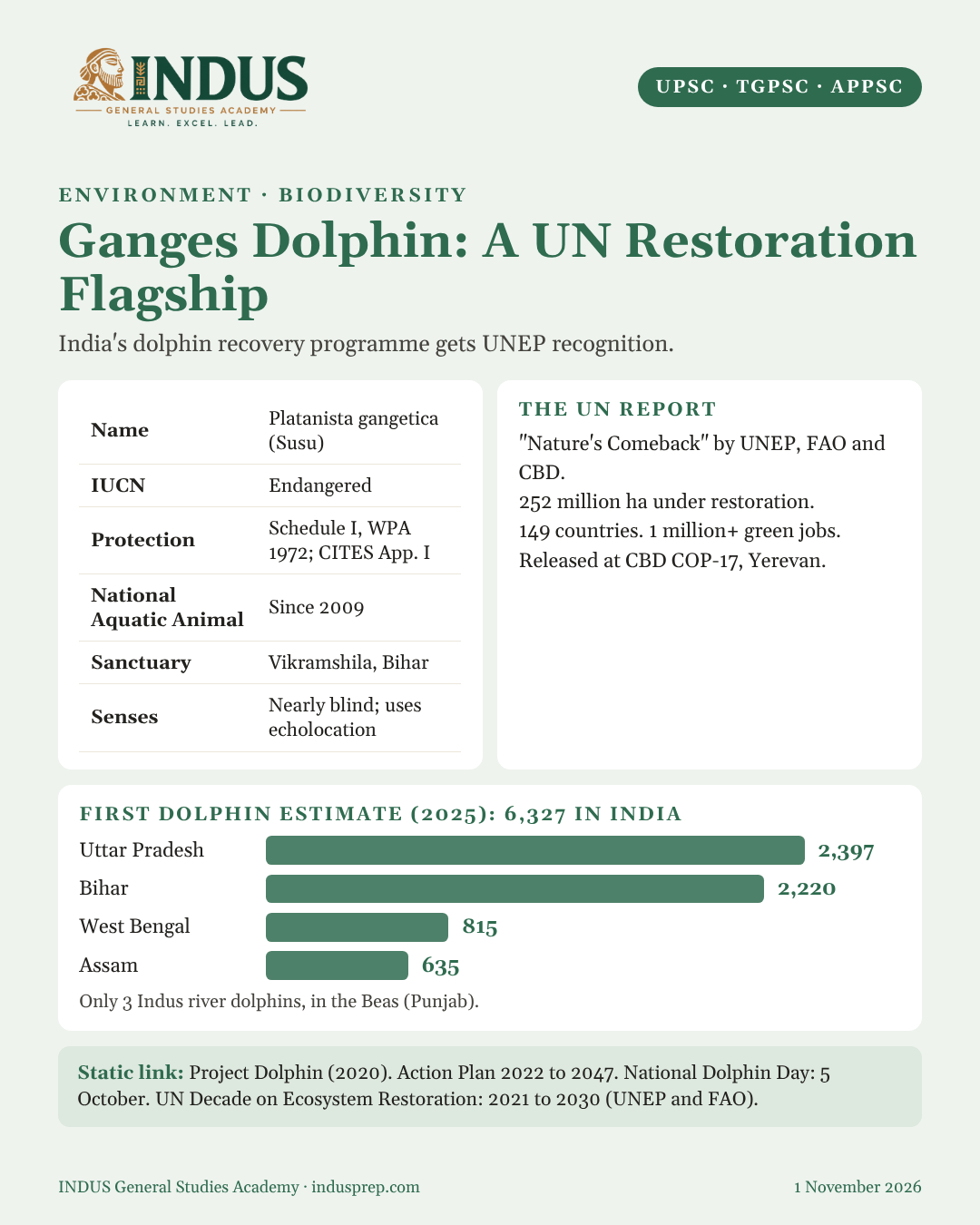
Environment
UNEP Names India's Ganges River Dolphin Programme a World Restoration Flagship
In news
- India's Ganges river dolphin recovery programme was recognised as a UN World Restoration Flagship.
- It features among the 35 flagships in the report "Nature's Comeback: Scaling Ecosystem Restoration for People and Planet".
- The report was released at the CBD COP-17 in Yerevan, Armenia.
About the report
- Published jointly by UNEP, FAO and the CBD Secretariat.
- Released at the midpoint of the UN Decade on Ecosystem Restoration (2021 to 2030).
| Finding | Detail |
|---|---|
| Area under restoration | About 252 million hectares |
| Countries | 149 |
| Green jobs created | Over 1 million |
| Weakest areas | Freshwater and marine ecosystems |
| Finance gap | Investment must rise from about US$64 billion to US$296 billion a year by 2030 |
- Verdict: restoration is working, but progress is too slow to meet 2030 targets.
What is a World Restoration Flagship
- A large-scale restoration project recognised under the UN Decade on Ecosystem Restoration.
- Flagships get UN visibility, technical support and access to funding.
- India's Namami Gange was named a flagship earlier, in 2022.
Why India's programme was chosen
- It combines species conservation, river restoration and livelihoods.
- Community participation: fishers, local youth and Ganga Praharis help in monitoring, rescue and eco-tourism.
- It reduces accidental deaths in fishing nets.
- It works with the National Mission for Clean Ganga on river flows and pollution.
About the Ganges river dolphin
| Feature | Detail |
|---|---|
| Scientific name | Platanista gangetica |
| Local name | Susu |
| Status | Endangered (IUCN) |
| Protection | Schedule I, Wild Life (Protection) Act, 1972; CITES Appendix I |
| National Aquatic Animal | Since 2009 |
| Habitat | Ganga, Brahmaputra and Meghna river systems (India, Nepal, Bangladesh) |
- It is almost blind and hunts by echolocation.
- It must surface to breathe every 30 to 120 seconds.
- It is an indicator species. Its presence shows a healthy river.
- It is also Assam's State Aquatic Animal.
Population status
- India's first river dolphin population estimate (released in March 2025) counted 6,327 river dolphins.
- Survey covered 28 rivers in 8 States, over about 8,500 km.
- Highest numbers: Uttar Pradesh (2,397), Bihar (2,220), West Bengal (815) and Assam (635).
- Only 3 Indus river dolphins were found, in the Beas river in Punjab.
Threats
- Barrages and dams fragment habitats and reduce flow.
- Pollution from industry, sewage and agriculture.
- Sand mining and dredging.
- Bycatch in gill nets.
- Noise from boats, which disturbs echolocation.
India's conservation efforts
- Project Dolphin (2020): for river and marine dolphins.
- Comprehensive Action Plan for Dolphin Conservation (2022 to 2047).
- Vikramshila Gangetic Dolphin Sanctuary, Bihar: India's only sanctuary for the species.
- National Dolphin Day: 5 October.
Static connect
- UN Decade on Ecosystem Restoration (2021 to 2030): led by UNEP and FAO.
- Kunming-Montreal Global Biodiversity Framework, Target 2: restore 30% of degraded ecosystems by 2030.
- Bonn Challenge: restore 350 million hectares of degraded land by 2030. India pledged 26 million hectares.
Exam relevance: UPSC Prelims and GS-3 (Biodiversity, Conservation); TGPSC, APPSC (Environment).
Get the full month in one PDF
The Current Affairs Monthly covers every important item in English and Telugu, with Group 1 points.
Browse current affairs material