
All current affairs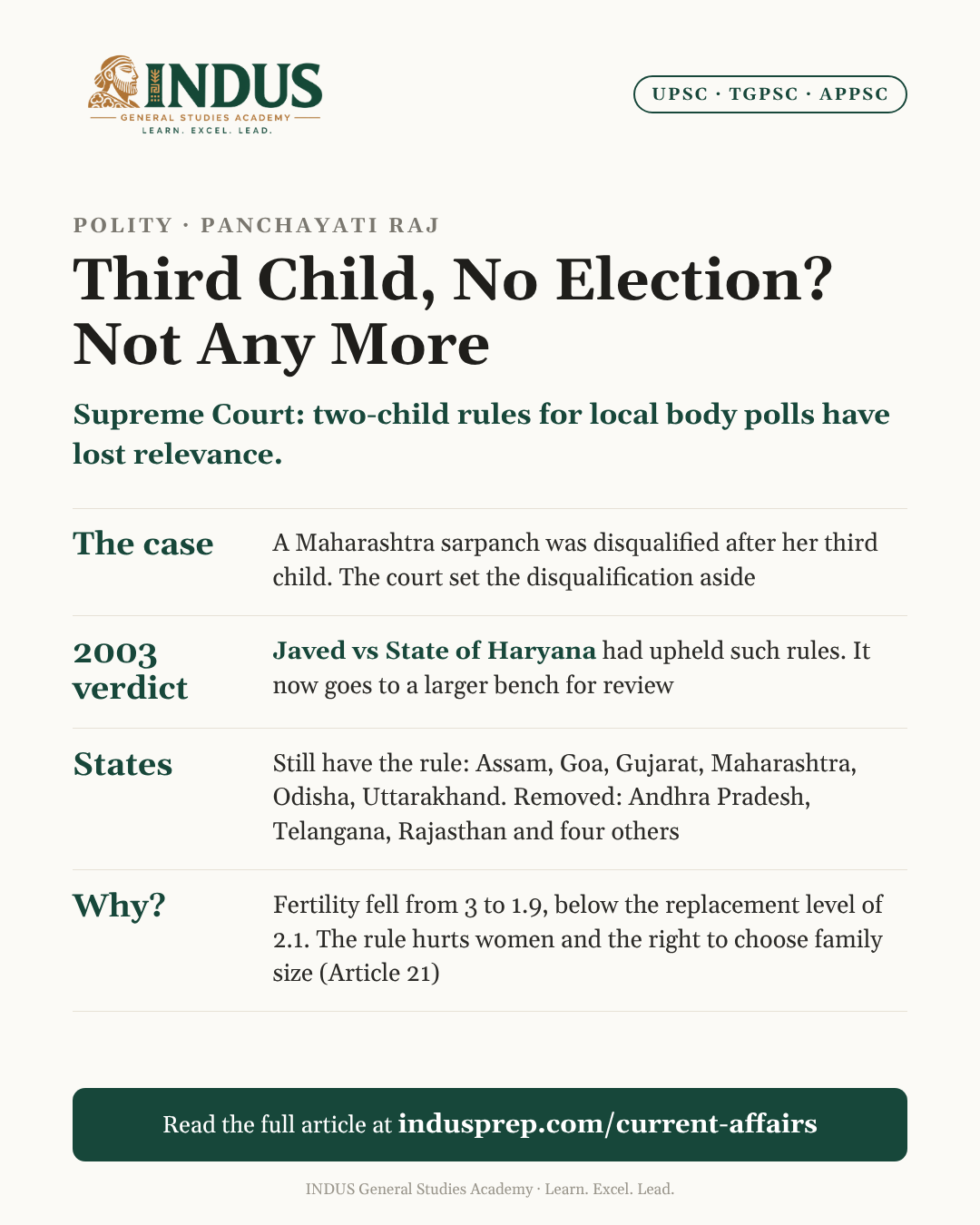
National
Two-Child Bar for Local Polls Has Lost Relevance: Supreme Court
In news
- The Supreme Court (4 November 2026) set aside the disqualification of a former sarpanch in Maharashtra for having more than two children.
- It said laws penalising a third child have "lost all relevance" in modern India.
- It referred the 2003 Javed vs State of Haryana judgment to a larger bench for review.
The case
| Item | Detail |
|---|---|
| Petitioner | Mangala Bhimrao, former sarpanch, Kakoda Gram Panchayat (Maharashtra) |
| Law | Section 14(1)(j-1), Maharashtra Village Panchayats Act, 1959; bar in force since September 2000 |
| Earlier | Disqualified after her third child; Bombay High Court upheld it in 2025 |
| Bench | Justices P.S. Narasimha and Alok Aradhe |
| Verdict | Disqualification set aside; Javed judgment sent to a larger bench |
What the court said
- Basis has collapsed: the fear of overpopulation behind these laws has faded.
- Fertility fall: India's Total Fertility Rate fell from about 3 (2003) to 1.9 now, below the replacement level of 2.1.
- Reproductive autonomy (Article 21): the law forces an unfair choice between having children and taking part in democracy.
- Arbitrary (Article 14): it targets only local representatives on outdated assumptions.
- Women hit hardest: reports of forced abortions, desertion of pregnant wives and denial of paternity to escape disqualification.
- Global lesson: China, cited in Javed, ended its one-child policy in 2015 and now encourages more births.
Javed vs State of Haryana (2003)
- A three-judge bench upheld the Haryana Panchayati Raj Act, 1994, which barred people with more than two living children from panchayat polls.
- Reasoning then:
- The right to contest elections is a statutory right, not a fundamental right. It can be restricted by law.
- Population control is in the national interest; the classification is reasonable.
- This ruling had guided similar laws across States for over two decades.
Where States stand
| Status | States |
|---|---|
| Still have the norm (6) | Assam, Goa, Gujarat, Maharashtra, Odisha, Uttarakhand |
| Repealed (7) | Haryana, Himachal Pradesh, Madhya Pradesh, Chhattisgarh (in the 2000s); Andhra Pradesh (2024); Telangana (2026); Rajasthan (2026) |
| Never had it | 15 States |
- Andhra Pradesh: scrapped the rule after about 30 years. The State now encourages larger families due to falling births and ageing.
- Telangana: Assembly passed the Telangana Panchayat Raj (Amendment) Bill, 2026 in January to end the norm. Rural fertility in the State has fallen to about 1.7.
The fertility angle
- NFHS-5 (2019-21): national TFR of 2.0. Only five States were above 2.1: Bihar, Meghalaya, Uttar Pradesh, Jharkhand, Manipur.
- Southern States have fertility well below replacement. They face early ageing and a shrinking working-age population.
- Demographic dividend is time-bound. Low fertility without enough jobs, health and pensions creates a burden.
- Policy focus is shifting from population control to population management: health, education, women's work and elder care.
Why the verdict matters
- Opens the door to uniform, fair eligibility rules for local body polls.
- Strengthens reproductive rights as part of Article 21.
- Recognises that coercive population measures do not work; education and health do.
- Note: a separate rule for government jobs was upheld in 2024 (Rajasthan police recruitment). The new reference concerns elections.
Static connect
- Article 243F: a State law can lay down disqualifications for panchayat members.
- Entry 20A, Concurrent List ("Population control and family planning"): added by the 42nd Amendment, 1976.
- National Population Policy, 2000: voluntary, target-free approach; stable population by 2045.
- ICPD, Cairo (1994): shifted the world from population targets to reproductive rights.
- Replacement level fertility (2.1): the TFR at which a generation exactly replaces itself.
Exam relevance: UPSC Prelims and GS-2 (Polity, Panchayati Raj, Judiciary), GS-1 (Population); TGPSC, APPSC (Polity, Telangana and Andhra Pradesh affairs).
Get the full month in one PDF
The Current Affairs Monthly covers every important item in English and Telugu, with Group 1 points.
Browse current affairs material