
All current affairs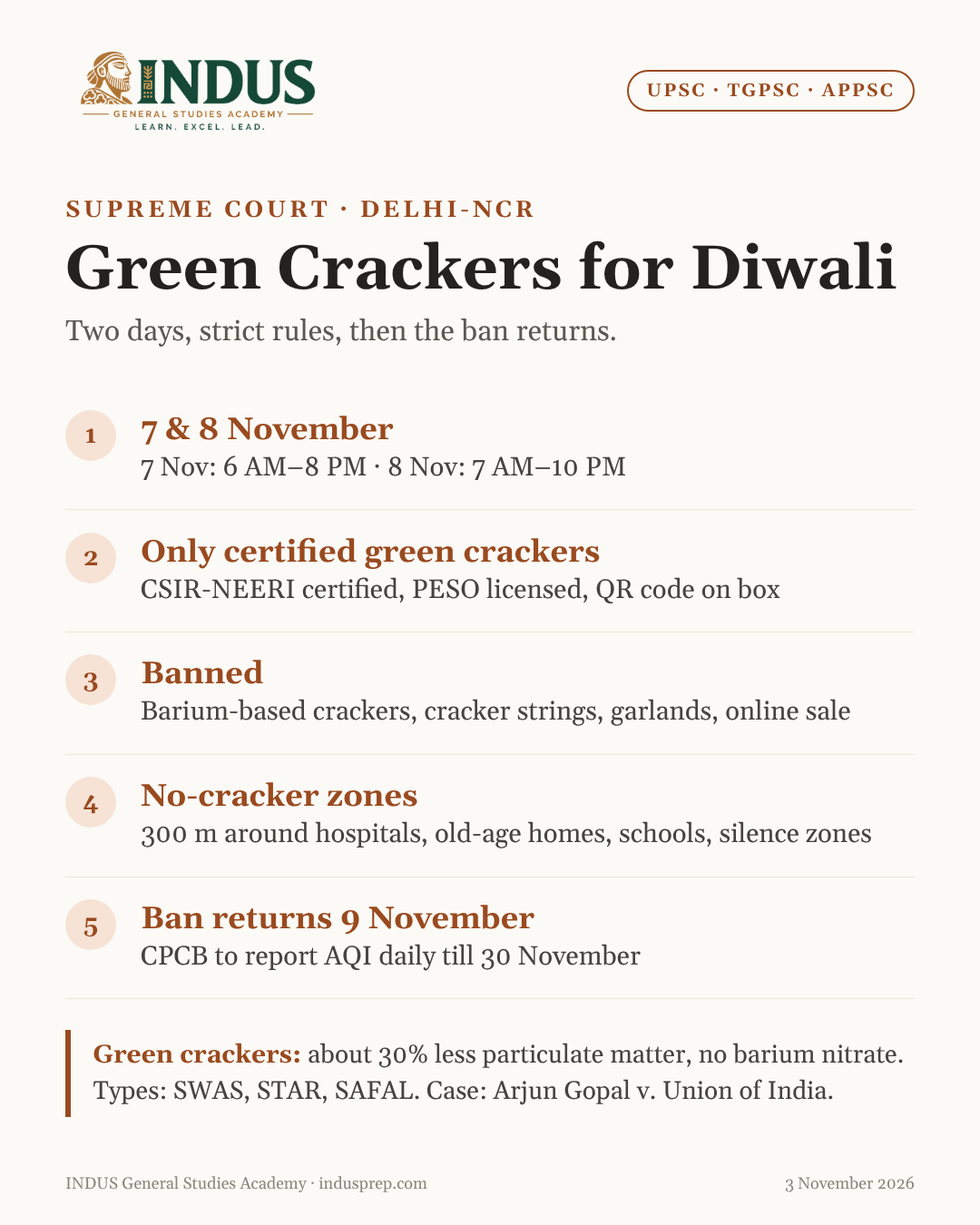
Environment
Supreme Court Allows Certified Green Crackers in Delhi-NCR for Two Diwali Days
In news
- The Supreme Court allowed bursting of certified green crackers in Delhi-NCR for Diwali.
- The case is Arjun Gopal v. Union of India.
- The year-round ban on firecrackers in Delhi-NCR resumes on 9 November 2026.
What the Court allowed
| Item | Detail |
|---|---|
| Days and timings | 7 Nov: 6 AM to 8 PM · 8 Nov: 7 AM to 10 PM |
| Sale | Only at sites fixed by District Collectors; no online sale |
| Who can make | Only manufacturers with CSIR-NEERI certification and a PESO licence |
| Packaging | Sealed boxes with a QR code showing manufacturer, licence and formulation |
| Banned | Cracker strings (ladis), garlands and barium-based crackers |
| No-cracker zones | Within 300 m of hospitals, old-age homes, educational institutions and silence zones |
- CPCB and State Pollution Control Boards must report AQI daily from 2 to 30 November.
- The Court applied the precautionary principle: act early to prevent harm, even without full scientific certainty.
- It warned officials of contempt for non-compliance.
What are green crackers?
- Developed by CSIR-NEERI (National Environmental Engineering Research Institute, Nagpur).
- Emit about 30% less particulate matter than conventional crackers.
- Do not contain barium nitrate, one of the most harmful chemicals in crackers.
- Identified by a green logo and QR code.
- Types:
- SWAS (Safe Water Releaser): releases water vapour that suppresses dust.
- STAR (Safe Thermite Cracker): no potassium nitrate or sulphur.
- SAFAL (Safe Minimal Aluminium): uses less aluminium, more magnesium.
- Limitation: "less polluting" is not "non-polluting". They still release fine particles.
About AQI
- India's National Air Quality Index was launched in 2014.
- It uses 8 pollutants:
- PM10
- PM2.5
- Nitrogen dioxide (NO2)
- Sulphur dioxide (SO2)
- Carbon monoxide (CO)
- Ozone (O3)
- Ammonia (NH3)
- Lead (Pb)
- Six categories: Good (0 to 50), Satisfactory (51 to 100), Moderate (101 to 200), Poor (201 to 300), Very Poor (301 to 400), Severe (401 to 500).
- Crackers mainly raise PM2.5, PM10, SO2 and NO2, and add metal particles.
Static connect
- PESO (Petroleum and Explosives Safety Organisation): regulates explosives; under the DPIIT, Ministry of Commerce and Industry; headquarters in Nagpur.
- Sivakasi (Tamil Nadu) is India's main firecracker manufacturing hub.
- Article 21: the Supreme Court has read the right to a clean environment and health into the right to life.
- Noise: firecracker noise is regulated under the Environment (Protection) Act, 1986.
Balancing the issue
- Public health: Diwali falls in Delhi's worst air season, with stubble smoke and calm winds.
- Festive traditions and livelihoods: lakhs of workers in Sivakasi depend on the industry.
- The Court's approach: a limited, regulated window instead of a total ban or a free-for-all.
Exam relevance: UPSC Prelims, GS-3 (Environment, Pollution), GS-2 (Judiciary); TGPSC, APPSC (Environment).
Get the full month in one PDF
The Current Affairs Monthly covers every important item in English and Telugu, with Group 1 points.
Browse current affairs material