
All current affairs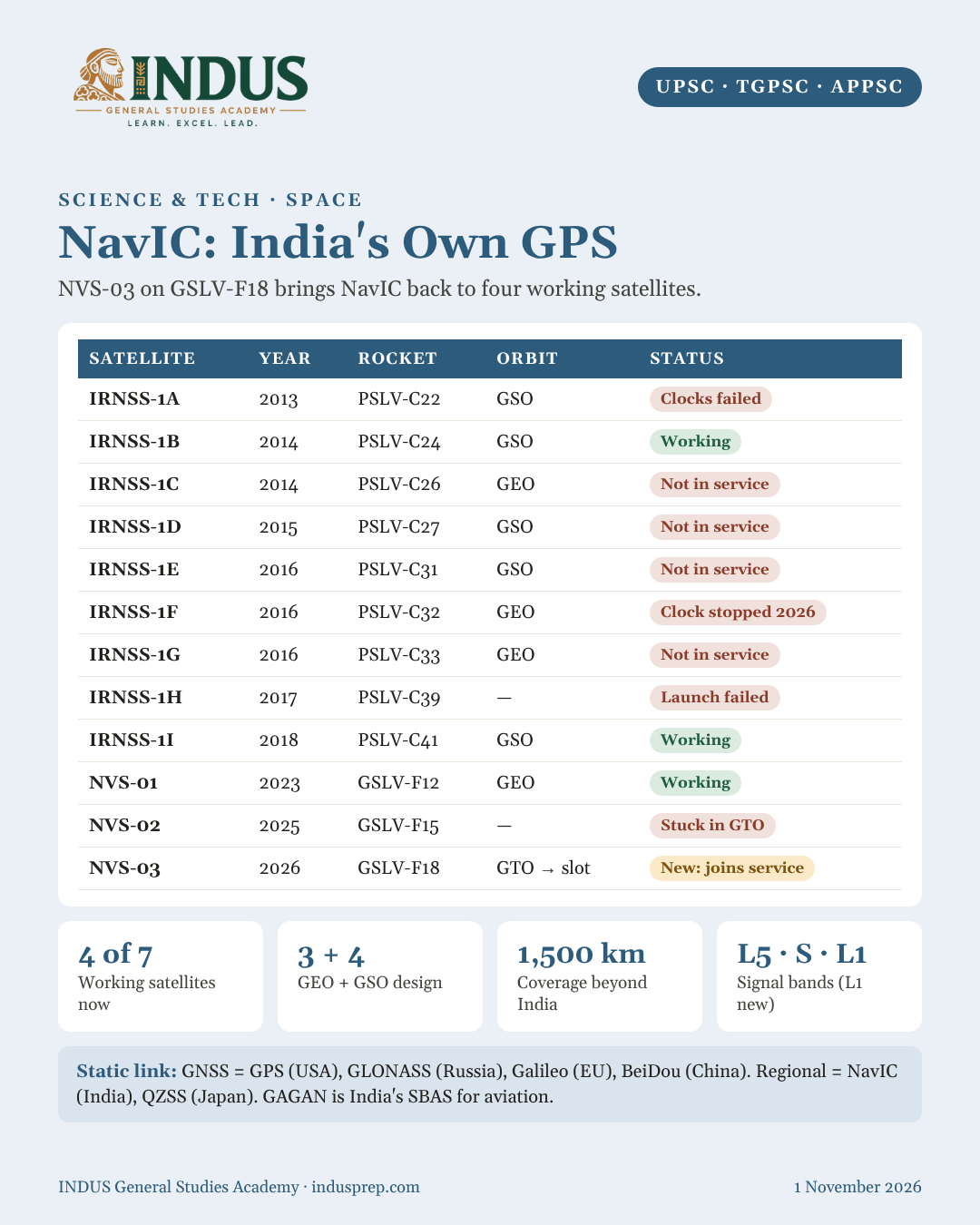
Science & Tech
NVS-03 Launched: NavIC Back to Four Working Satellites
In news
- ISRO launched NVS-03 on GSLV-F18 from the Second Launch Pad, Satish Dhawan Space Centre, Sriharikota, on 30 October 2026.
- The satellite was placed in a Geosynchronous Transfer Orbit (GTO). It will be raised to its final slot using its own engine.
- It is the third satellite of the NVS series, the second generation of NavIC.
Why it matters
- NavIC needs at least four satellites to give a position fix.
- It had fallen below this level after the last atomic clock on IRNSS-1F stopped in March 2026.
- With NVS-03, the working satellites are IRNSS-1B, IRNSS-1I, NVS-01 and NVS-03.
- The full constellation needs seven satellites.
NVS-03 at a glance
| Feature | Detail |
|---|---|
| Launch vehicle | GSLV-F18 (20th GSLV flight) |
| Atomic clock | Indigenous rubidium clock (iRAFS) plus procured clocks |
| Signals | L5 and S bands, plus the new L1 band |
| Coverage | India and about 1,500 km beyond its boundary |
| Lesson from NVS-02 | Pyro valves opened on the ground to avoid an in-flight valve failure |
What is NavIC
- NavIC (Navigation with Indian Constellation) is India's regional navigation satellite system. Its technical name is IRNSS.
- It was approved in 2006. The name NavIC was given in 2016.
- It is designed with 3 satellites in Geostationary Orbit (GEO) and 4 in inclined Geosynchronous Orbit (GSO).
- It offers two services:
- Standard Positioning Service (SPS) for civilian users.
- Restricted Service (RS), encrypted, for strategic users.
- Position accuracy is better than 20 m over the primary service area.
- Ground control is at the ISRO Navigation Centre, Byalalu (Karnataka).
The NavIC journey
| Satellite | Launch | Vehicle | Status |
|---|---|---|---|
| IRNSS-1A | 2013 | PSLV-C22 | Atomic clocks failed |
| IRNSS-1B | 2014 | PSLV-C24 | Working |
| IRNSS-1C | 2014 | PSLV-C26 | Not in navigation service |
| IRNSS-1D | 2015 | PSLV-C27 | Not in navigation service |
| IRNSS-1E | 2016 | PSLV-C31 | Not in navigation service |
| IRNSS-1F | 2016 | PSLV-C32 | Last clock stopped in 2026 |
| IRNSS-1G | 2016 | PSLV-C33 | Not in navigation service |
| IRNSS-1H | 2017 | PSLV-C39 | Launch failed (heat shield did not separate) |
| IRNSS-1I | 2018 | PSLV-C41 | Working |
| NVS-01 | 2023 | GSLV-F12 | Working; first indigenous atomic clock |
| NVS-02 | 2025 | GSLV-F15 | Stuck in transfer orbit (valve fault) |
| NVS-03 | 2026 | GSLV-F18 | Launched; joins the working set |
Key concepts
- Atomic clocks are the heart of a navigation satellite. A timing error of one nanosecond means about 30 cm of position error.
- The early IRNSS satellites used imported rubidium clocks. Many of them failed.
- The L1 band is used by GPS and most phone chipsets. Adding L1 makes NavIC easier to use in smartphones.
- 3GPP recognised NavIC for mobile phones in 2020. The IMO accepted it as part of the World-Wide Radio Navigation System in 2020.
Applications
- Vehicle tracking (mandatory in public transport trackers under AIS-140).
- Alerts to fishermen at sea.
- Disaster management and mapping.
- Precise timing for power grids, telecom and banking.
- Defence and strategic use, with no dependence on foreign systems during conflicts.
Static connect
- Global systems (GNSS): GPS (USA), GLONASS (Russia), Galileo (European Union), BeiDou (China).
- Regional systems: NavIC (India), QZSS (Japan).
- GAGAN (GPS Aided GEO Augmented Navigation) is a Satellite-Based Augmentation System (SBAS) of ISRO and the Airports Authority of India. It improves GPS accuracy for civil aviation.
- GSLV uses an indigenous cryogenic upper stage (CUS).
Way forward
- Launch NVS-04 and NVS-05 quickly to complete the seven-satellite constellation.
- Build a proven record for indigenous atomic clocks.
- Push NavIC-enabled chipsets in phones and vehicles.
- Plan for expansion of coverage beyond the region.
Exam relevance: UPSC Prelims and GS-3 (Space technology); TGPSC, APPSC (Science and Technology).
Get the full month in one PDF
The Current Affairs Monthly covers every important item in English and Telugu, with Group 1 points.
Browse current affairs material