
Mains Corner
More Jobs, Not Better Jobs: India's Decent Work Deficit
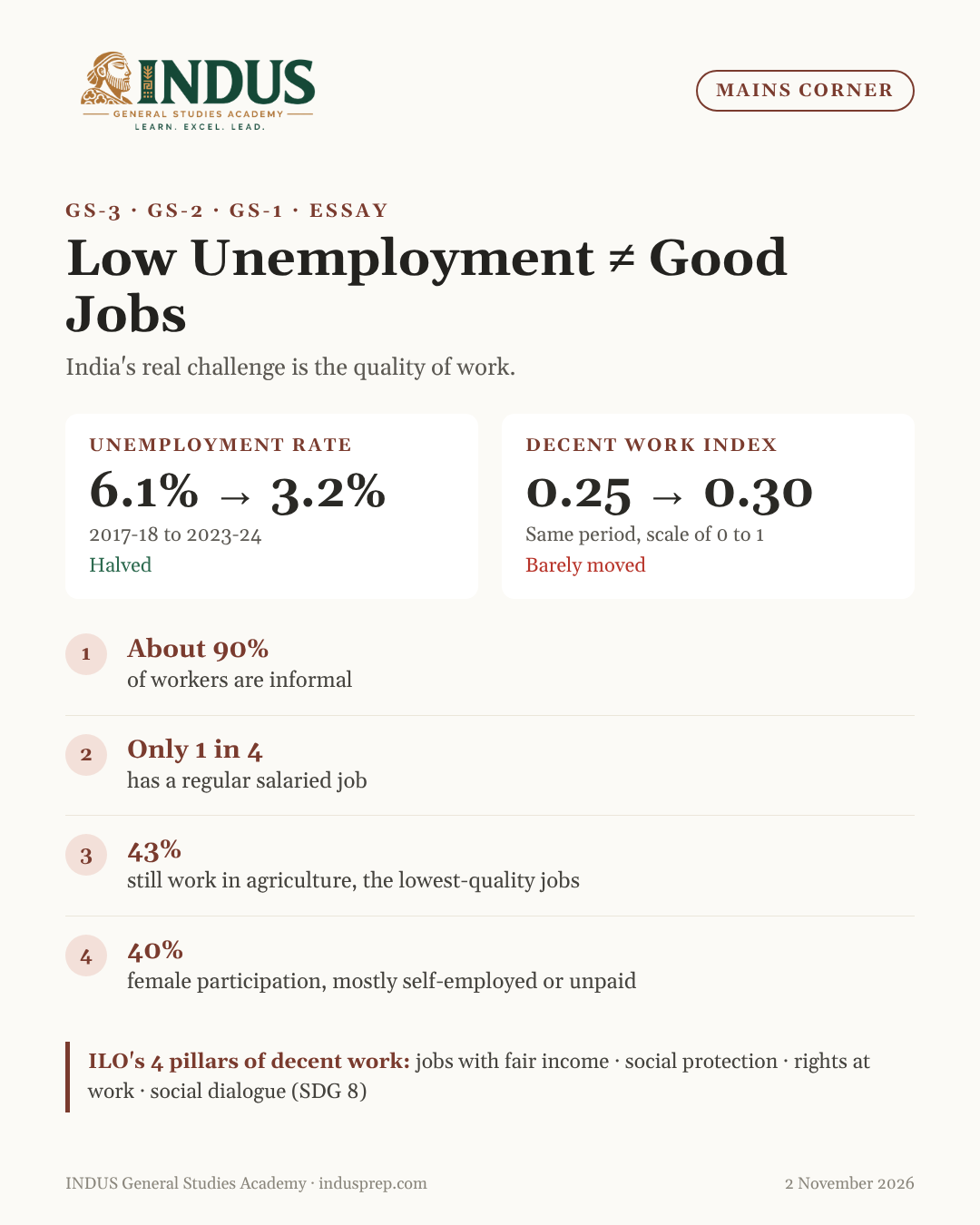
GS mapping: GS-3 (Employment, Inclusive growth) | GS-2 (Welfare of vulnerable sections) | GS-1 (Women, Social empowerment) | Essay
Why in news: Recent analyses show that India's unemployment rate has fallen sharply, but a Decent Work Index built on official labour data has improved only slightly. The debate has shifted from "how many jobs" to "what kind of jobs".
The paradox
India's unemployment rate is at a record low of about 3%. On paper, almost everyone who wants work has it.
Yet lakhs of young people apply for a handful of government posts. Graduates say they cannot find "proper jobs". Wages for most workers have barely moved.
- In India, the poor cannot afford to be unemployed. They take whatever work is available.
- So a low unemployment rate hides a deeper problem: too many people in low-paid, insecure work.
- The challenge is no longer jobs alone. It is decent jobs.
Why the unemployment rate misleads
The unemployment rate only counts whether a person worked. It says nothing about the quality of that work.
- Unpaid family helpers on a farm or in a family shop are counted as employed.
- Disguised unemployment: more people work on a farm than the work needs. Removing some would not reduce output.
- Underemployment: people work fewer hours than they want, or in jobs below their skills.
- Working poor: people who work full time but still earn too little to escape poverty.
What is "decent work"?
The International Labour Organization (ILO) set out the Decent Work Agenda in 1999. It has four pillars:
- Employment creation: productive jobs with fair income.
- Social protection: health cover, pension, maternity and accident benefits.
- Rights at work: safe workplaces, no forced or child labour, no discrimination.
- Social dialogue: a voice for workers through unions and collective bargaining.
Decent work is part of SDG 8: Decent Work and Economic Growth.
India's job picture
- Unemployment rate: fell from 6.1% (2017-18) to 3.2% (2023-24), and about 3.1% in 2025.
- Youth unemployment (15 to 29): still about 10%.
- Decent Work Index: rose only from 0.25 to 0.30 (on a 0 to 1 scale) over the same period.
- Informality: about 90% of workers are informal.
- Regular salaried jobs: only about 1 in 4 workers (23.6% in 2025).
- Self-employment: more than half of all workers are self-employed, many in small, low-income activities.
- Agriculture: still employs about 43% of workers, but has the lowest job quality.
- Manufacturing: has the highest job quality, but employs relatively few.
- Women: participation has risen to 40%, but mostly as self-employed or unpaid helpers.
- Social groups: job quality for women from Scheduled Tribes and OBCs declined, even as it improved for men.
The core problem is wages and security, not just the number of jobs.
Why it matters
1. Weak demand slows the economy
When most workers earn low wages, they spend little. Low consumption means low demand for goods, which slows investment and growth. Decent wages are not only a social goal. They drive the economy.
2. No safety net for most workers
Informal workers have no pension, health insurance, paid leave or job security. One illness or job loss can push a family into debt and poverty.
3. The demographic dividend is at risk
India's young workforce can raise growth only if it works in productive jobs. Millions stuck in low-productivity farm and informal work cannot deliver the dividend.
4. Rising inequality
When most workers earn little, the gains of growth go mainly to capital owners and a small skilled workforce. Inequality widens.
5. Gender and social gaps grow
Women and marginalised groups are concentrated in the lowest-quality jobs. Without decent work, their economic empowerment stays on paper.
6. Youth frustration and social unrest
Educated youth who cannot find jobs that match their skills feel let down. This fuels migration pressure, protests and demand for reservation in government jobs.
7. Poverty in old age
Today's informal worker is tomorrow's elderly person without a pension. The decent work deficit becomes an ageing crisis later.
Root causes
- Stalled structural transformation: workers left farms, but moved mostly to construction and informal services, not to factories.
- Manufacturing has not absorbed labour: factories have become more capital-intensive.
- MSME constraints: small firms face poor credit access and heavy compliance, so they stay small and informal.
- Skill mismatch: education does not match what employers need.
- Contractualisation: even formal firms hire workers on short contracts without benefits.
- Gig and platform work: growing fast, but without fixed wages or social security.
- Automation and AI: pressure on routine and entry-level jobs.
Is India responding?
Labour reforms
- Four Labour Codes came into force on 21 November 2025: Wages, Industrial Relations, Social Security, and Occupational Safety, Health and Working Conditions.
- The Code on Social Security, 2020 recognises gig and platform workers for the first time.
- Code on Wages provides for a national floor wage.
- e-Shram portal: a national database of unorganised workers.
Job creation
- PM Viksit Bharat Rozgar Yojana (2025): the Employment Linked Incentive scheme; aims to support about 3.5 crore new jobs, mainly first-time formal jobs.
- Production Linked Incentive (PLI) schemes for manufacturing.
- PM Internship Scheme for youth in top companies.
Skills and livelihoods
- Skill India Mission and PMKVY.
- Rural employment guarantee as a safety net.
- DAY-NRLM: self-help groups for rural women's livelihoods.
Ease of compliance
- Jan Vishwas laws decriminalise minor business offences. Lower compliance burden helps MSMEs grow and formalise.
The verdict
- Most schemes focus on creating jobs, not on improving job quality.
- Social security for gig and informal workers is still in its early stages.
- India still measures success by the unemployment rate, not by decent work.
Way forward
- Labour-intensive manufacturing: textiles, food processing, footwear, toys, furniture and tourism.
- MSME support: cheaper credit, simpler compliance, and incentives to formalise.
- Universal social security floor: basic health, pension and accident cover for all workers, including gig workers.
- Wages: notify and enforce the national floor wage; publish regular wage data.
- Urban employment guarantee: pilot schemes for the urban poor.
- Skilling linked to industry: apprenticeships and on-the-job training.
- Women's work: crèches, safe transport, and care economy jobs.
- Measure what matters: adopt an official Decent Work Index alongside the unemployment rate.
Connect the dots
| Related topic | The connection |
|---|---|
| Gig and platform economy | Fast-growing job source, but without job security, fixed wages or social protection |
| AI and automation | Threatens routine and entry-level jobs; reskilling and safety nets become urgent |
| Demographic dividend | A young workforce in low-quality jobs cannot deliver the growth the dividend promises |
| Women's work and the care economy | Women's rising participation is mostly unpaid or self-employed; the care burden keeps them out of decent jobs |
| Skilling and education–job mismatch | Graduates lack employable skills, while employers report skill shortages |
| MSMEs and formalisation | MSMEs employ the most people but stay small and informal due to credit and compliance burdens |
| Labour Codes and social security | Reforms aim to extend protection to unorganised and gig workers; implementation is the test |
| Structural transformation | Workers are shifting from farms to informal services and construction, not factories |
| Migration and urbanisation | Migrant workers fill city jobs without housing, portable benefits or job security |
| Inequality and inclusive growth | Low wages and informality concentrate the gains of growth at the top |
Conclusion
India has solved the problem of open unemployment, but not the problem of poor-quality work. Growth that does not create decent jobs cannot be called inclusive. The next phase of labour policy must shift its target from "more jobs" to "better jobs".
Mains toolkit
Keywords for answers: jobless growth, decent work deficit, working poor, disguised unemployment, underemployment, precarity, missing middle, informalisation of the formal sector, structural transformation, Lewis model, national floor wage
Practice questions
- "A low unemployment rate in India hides a deficit of decent work." Explain with suitable examples. (150 words, 10 marks)
- India's labour market is marked by high informality and low wages despite falling unemployment. Analyse the causes and suggest measures to promote decent work in line with SDG 8. (250 words, 15 marks)
Get the full month in one PDF
The Current Affairs Monthly covers every important item in English and Telugu, with Group 1 points.
Browse current affairs material