
All current affairs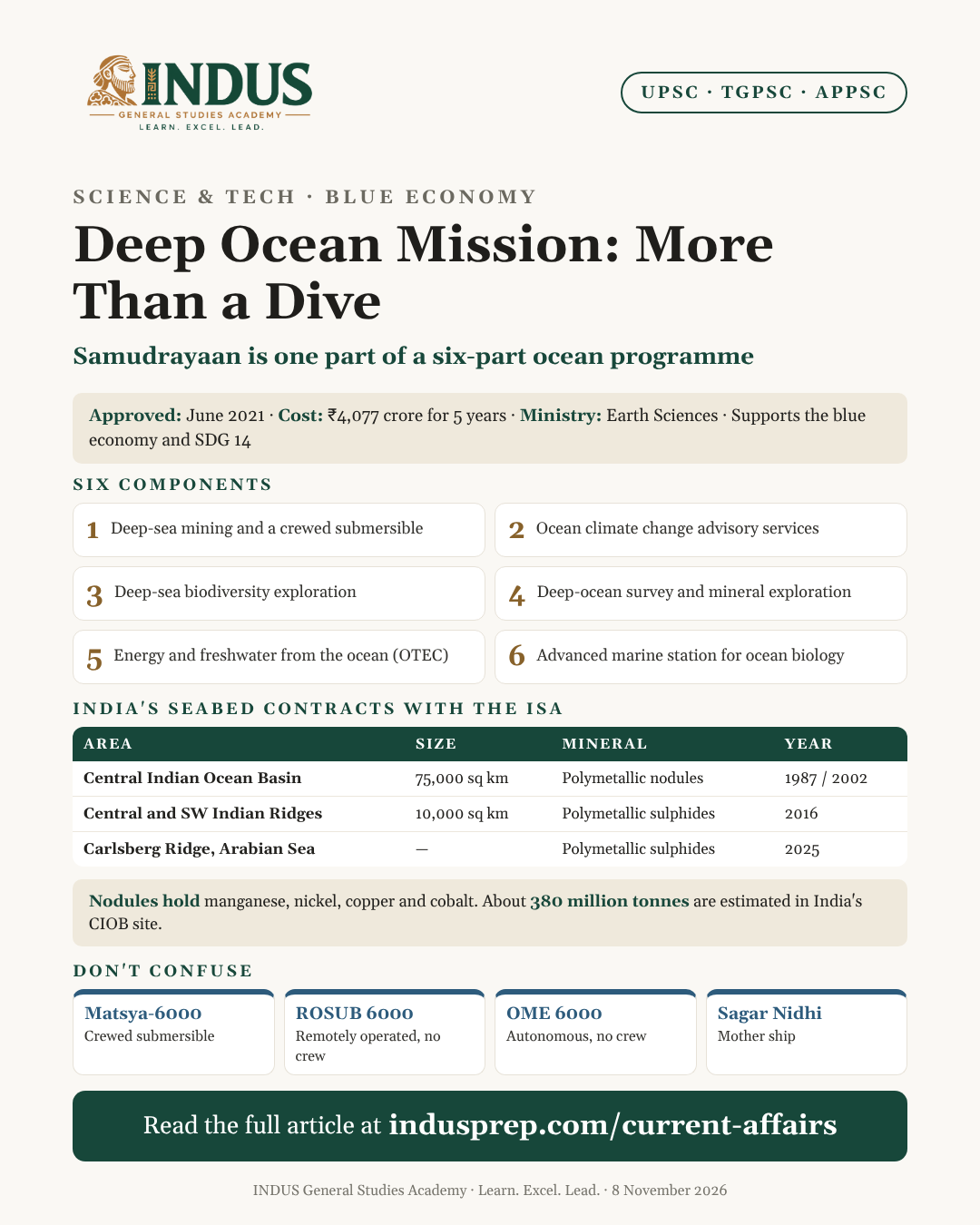
Science & Tech
Matsya-6000 Clears Unmanned Trials as India Targets a 6,000-Metre Human Dive by 2028
In news
- Matsya-6000, India's first crewed deep-sea submersible, has cleared a series of unmanned trials in the presence of the Secretary, Ministry of Earth Sciences (MoES).
- Systems tested: flotation (buoyancy), stability and control under water, and ballast systems (depth control).
- The vehicle has been cleared for the next phase of testing.
- On 4 November 2026, at the Indo-Pacific Regional Dialogue (IPRD) 2026, Union Minister Dr Jitendra Singh said India will send its first human deep-sea mission to up to 6,000 metres by 2028.
- The trials for these depths will be held in the Central Indian Ocean Basin (CIOB).
What is Samudrayaan?
- Samudrayaan is India's first crewed deep-ocean mission.
- It aims to send three humans to a depth of 6,000 metres inside the submersible Matsya-6000.
- It is a part of the Deep Ocean Mission (DOM) of the Ministry of Earth Sciences.
- Builder: National Institute of Ocean Technology (NIOT), Chennai, an autonomous institute under MoES.
- ISRO helped build the titanium crew sphere. DRDO and CSIR labs supplied several systems.
- Launched: October 2021, at Chennai.
- With this mission, India will join the US, Russia, France, Japan and China, the only countries that have sent crewed vehicles to such depths.
Matsya-6000 at a glance
| Feature | Details |
|---|---|
| Name | Matsya means fish in Sanskrit; 6000 is the target depth in metres |
| Type | Fourth-generation, self-propelled, human-occupied scientific submersible |
| Crew | 3 (one pilot and two scientists) |
| Crew sphere | Titanium alloy (Ti6Al4V-ELI); 2.1 m inner diameter; 80 mm thick wall; made by electron beam welding |
| Pressure | Rated for about 600 bar, which is about 600 times the air pressure at sea level |
| Endurance | 12 hours normally: about 4 hours to go down, 4 hours on the seabed and 4 hours to come up |
| Emergency | Life support for 96 hours (61 oxygen cylinders) |
| Weight | About 28 tonnes |
| Speed | Up to 3 knots using electric thrusters |
| Power | Lithium-polymer batteries |
| Tools | Two robotic arms, a sample tray, cameras, lights and sonar |
| Safety | Drop weights for emergency rise; a pop-up buoy with a satellite beacon; DNV certification for each component |
| Mother ship | ORV Sagar Nidhi, which will launch and recover the submersible |
How does it survive the deep?
- Pressure rises by about 1 bar for every 10 metres of sea water. At 6,000 m, the water presses on every square centimetre with roughly 600 kg of force.
- A sphere spreads this pressure evenly, so it is the strongest shape for a crew cabin.
- Titanium alloy is strong, light and does not corrode in seawater.
- Syntactic foam (tiny glass bubbles set in resin) gives buoyancy without collapsing under pressure. India imports this foam from France, and delays in its supply pushed back the timeline.
- Inside the sphere, the crew breathe at normal air pressure. Carbon dioxide scrubbers clean the air, and the cabin is kept at about 10°C.
Journey so far
| Year | Milestone |
|---|---|
| 1987 | India became the first country to get "Pioneer Investor" status for exploring polymetallic nodules in the Central Indian Ocean Basin |
| 2002 | Signed an exploration contract with the International Seabed Authority (ISA); kept 75,000 sq km in the CIOB |
| 2016 | Second ISA contract for polymetallic sulphides in 10,000 sq km of the Central and Southwest Indian Ridges |
| June 2021 | Union Cabinet approved the Deep Ocean Mission at a cost of ₹4,077 crore for five years |
| October 2021 | Samudrayaan was launched |
| 2024 | Over 100 kg of cobalt-rich nodules collected from 1,173 m in the Andaman Sea |
| Jan–Feb 2025 | Harbour wet tests at L&T Shipyard, Kattupalli (Tamil Nadu), with a steel test sphere and a crew of three |
| August 2025 | Two NIOT aquanauts dived in the French submersible Nautile in the North Atlantic: R. Ramesh to 4,025 m and Cdr (Retd) Jatinder Pal Singh to 5,002 m, the deepest dive by an Indian |
| 2025 | ISA contract to explore the Carlsberg Ridge (Arabian Sea) |
| November 2026 | Matsya-6000 cleared unmanned trials. Target: 6,000 m human dive by 2028 |
Where 6,000 metres fits
| Depth | What is found there |
|---|---|
| 0–200 m | Sunlit zone; most marine life |
| 500 m | Planned depth of Matsya-6000's first crewed sea trial |
| About 1,000 m | Sunlight ends completely |
| 3,800 m | Wreck of the Titanic |
| 4,000–6,000 m | Abyssal plains, where polymetallic nodules lie in the CIOB |
| 5,002 m | Deepest dive by an Indian (2025) |
| 6,000 m | Matsya-6000's target. About 98% of the ocean floor lies above this depth |
| About 10,900 m | Challenger Deep, Mariana Trench, the deepest point on Earth |
Why the mission matters
- Critical minerals: polymetallic nodules contain manganese, nickel, copper and cobalt, which are needed for batteries and electronics. About 380 million tonnes of nodules are estimated in India's CIOB site.
- Science: humans can observe and sample deep-sea life, hydrothermal vents and the seabed directly. As one scientist put it, no camera can match the human eye.
- Blue economy: India has an 11,098 km coastline and an Exclusive Economic Zone of over 2 million sq km.
- Technology: it builds Indian skills in life support, titanium welding, underwater navigation and robotics.
- Strategic presence: it strengthens India's position in the Indian Ocean, where China is active in deep-sea research.
- Two frontiers together: India is preparing humans for both space (Gaganyaan) and the deep sea (Samudrayaan).
Deep Ocean Mission: six components
- Deep-sea mining technology and a crewed submersible (Samudrayaan comes under this)
- Ocean climate change advisory services
- Deep-sea biodiversity exploration and conservation
- Deep-ocean survey and mineral exploration
- Energy and freshwater from the ocean, including an OTEC-powered desalination plant
- An advanced marine station for ocean biology
- Nodal ministry: Ministry of Earth Sciences.
- It supports India's blue economy and UN SDG 14 (Life Below Water).
Concerns
- Ecology: deep-sea mining can destroy fragile habitats that recover over thousands of years.
- No global mining rules yet: the ISA has still not finalised its Mining Code for commercial extraction.
- Import dependence: delays in the supply of foreign parts, such as syntactic foam, have slowed the mission.
- Human risk: the loss of the private submersible Titan near the Titanic wreck in 2023 showed why strict certification is essential.
Don't confuse
| Vehicle | Type | Depth | Note |
|---|---|---|---|
| Matsya-6000 | Crewed submersible | 6,000 m | For Samudrayaan; NIOT |
| ROSUB 6000 | Remotely operated vehicle (no crew) | 6,000 m | NIOT; used for deep-sea surveys |
| Ocean Mineral Explorer 6000 | Autonomous underwater vehicle (no crew) | 6,000 m | Maps mineral sites such as hydrothermal sulphides |
| Sagar Nidhi | Research ship | Surface | Launches and recovers Matsya-6000 |
Crewed deep submersibles of other countries
| Country | Submersible | Depth rating |
|---|---|---|
| USA | Alvin | 6,500 m |
| France | Nautile | 6,000 m |
| Russia | Mir-1 and Mir-2 | 6,000 m |
| Japan | Shinkai 6500 | 6,500 m |
| China | Jiaolong; Fendouzhe | 7,000 m; over 10,900 m |
| India | Matsya-6000 | 6,000 m (in development) |
Static connect
- International Seabed Authority (ISA): set up under UNCLOS (1982); started work in 1994; headquarters in Kingston, Jamaica. It regulates mining in the seabed beyond national limits, known as "the Area".
- NIOT, Chennai: established in 1993 under the Ministry of Earth Sciences.
- INCOIS, Hyderabad: the MoES institute that gives tsunami warnings and ocean forecasts.
- O-SMART: the MoES umbrella scheme for ocean services, technology, observations, resources, modelling and science.
Exam relevance: UPSC Prelims and GS-3 (Science and Technology, Indigenisation of technology, Blue economy, Conservation); GS-1 (Distribution of key natural resources); TGPSC, APPSC (Science and Technology).
Get the full month in one PDF
The Current Affairs Monthly covers every important item in English and Telugu, with Group 1 points.
Browse current affairs material