
All current affairs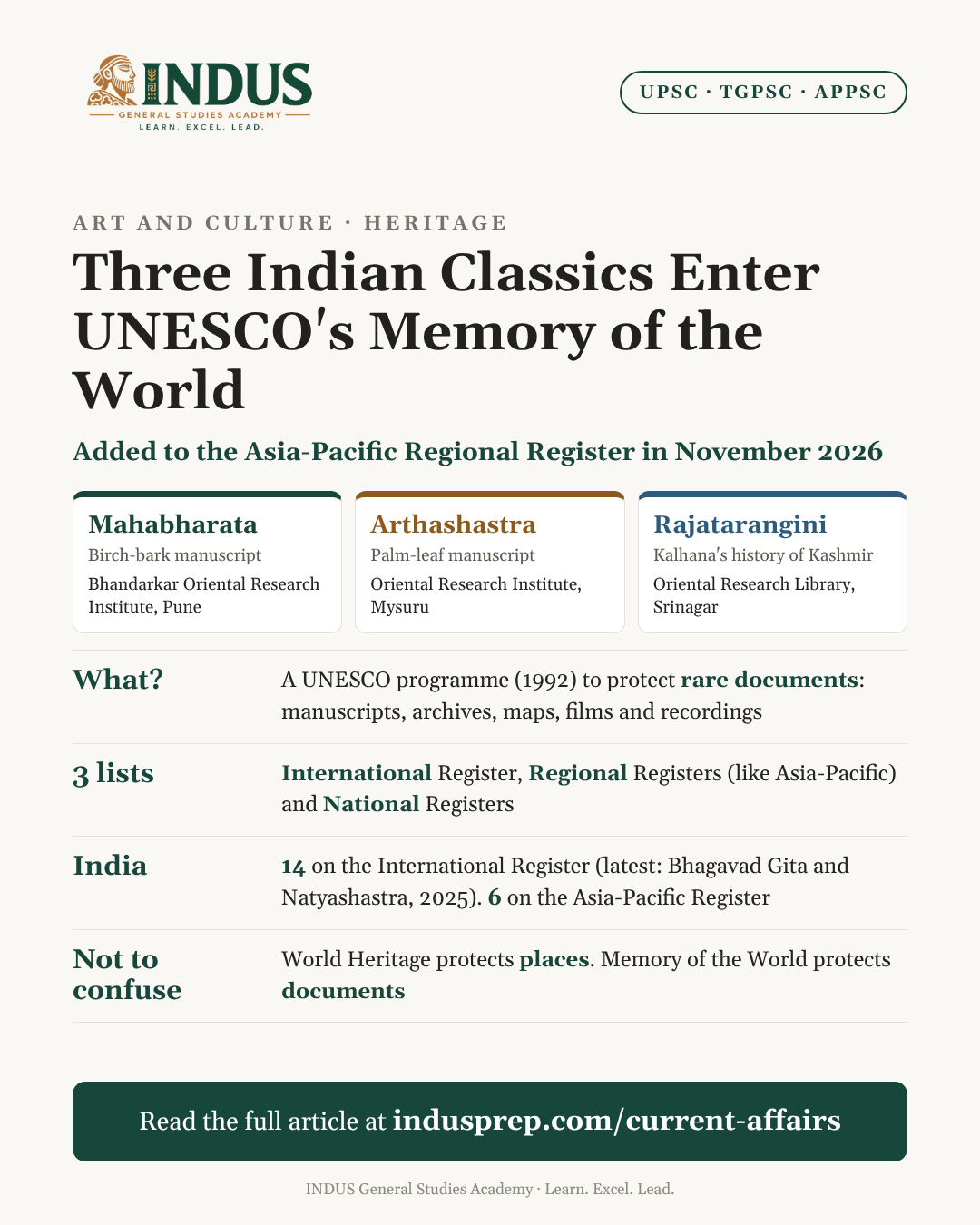
National
Mahabharata, Arthashastra and Rajatarangini Enter UNESCO's Memory of the World Register
In news
- Three Indian manuscripts have been inscribed on UNESCO's Memory of the World (MoW) Asia-Pacific Regional Register:
- the Mahabharata
- Kautilya's Arthashastra
- Kalhana's Rajatarangini
- The decision was taken at the 11th session of the Memory of the World Committee for Asia and the Pacific (MOWCAP) in Jakarta, Indonesia.
- The Ministry of Culture announced it on 5 November 2026.
- MOWCAP added 21 new items to the regional register in this cycle (2025–26).
- The Indira Gandhi National Centre for the Arts (IGNCA) prepared the nomination dossiers for all three.
- India now has six entries on the Asia-Pacific Regional Register.
The three inscriptions
| Manuscript | Material | Custodian |
|---|---|---|
| Mahabharata | Birch bark (bhurja-patra) | Bhandarkar Oriental Research Institute (BORI), Pune, Maharashtra |
| Arthashastra of Kautilya | Palm leaf | Oriental Research Institute, Mysuru, Karnataka |
| Rajatarangini of Kalhana | Manuscript | Oriental Research Library, Sri Pratap Singh Library complex, Srinagar, Jammu and Kashmir |
About the three texts
Mahabharata
- A Sanskrit epic, traditionally attributed to sage Vyasa.
- It has about one lakh verses in 18 parvas (books). It is often called the world's longest epic poem.
- Theme: the war between the Pandavas and Kauravas, with lessons on dharma, duty, justice and statecraft.
- The Bhagavad Gita is part of its Bhishma Parva.
- BORI prepared the Critical Edition of the Mahabharata between 1919 and 1966.
Arthashastra
- A Sanskrit treatise on statecraft, economy and administration, attributed to Kautilya (also called Chanakya or Vishnugupta). He is linked with Chandragupta Maurya.
- It covers taxation, trade, law, diplomacy, espionage and war. It has 15 books (adhikaranas).
- Key ideas:
- the Saptanga theory of the state (seven limbs: king, minister, territory, fort, treasury, army, ally)
- the Mandala theory of foreign relations
- The text was rediscovered in 1905 by R. Shamasastry at the Mysore library, now the Oriental Research Institute. He published it in 1909.
Rajatarangini
- Means "River of Kings". Written in Sanskrit verse by Kalhana in 1148–49 CE.
- A chronicle of the kings of Kashmir, in eight books (tarangas).
- It is often called the first proper work of history writing in India. Kalhana used inscriptions, coins and earlier records, and tried to be impartial.
- It describes dynasties such as the Karkotas (including Lalitaditya Muktapida) and the Utpalas.
What is the Memory of the World Programme?
- An initiative launched by UNESCO in 1992.
- Aim: to preserve the world's documentary heritage and make it accessible to all.
- Documentary heritage includes manuscripts, rare books, archives, maps, photographs, films and sound recordings.
- It works through an International Advisory Committee of 14 members, appointed by UNESCO's Director-General.
- It is a programme, not a convention. Inscription brings recognition and visibility, not legal obligations.
Three levels of registers
| Register | Who decides | Notes |
|---|---|---|
| International Register | UNESCO's Executive Board, on the advice of the International Advisory Committee | First inscriptions in 1997. About 570 items as of 2025 |
| Regional Registers | Regional committees, such as MOWCAP for Asia and the Pacific (set up in 1998) | MOWCAP normally inscribes items every two years |
| National Registers | National Memory of the World committees | Recognise heritage of national importance |
India's tally
- International Register: 14 entries. Examples:
- Rigveda manuscripts (2007)
- Gilgit Manuscripts (2017)
- Bhagavad Gita and Bharata's Natyashastra (2025)
- Asia-Pacific Regional Register: 6 entries.
- 2024 (10th MOWCAP meeting, Ulaanbaatar, Mongolia): Ramcharitmanas, Panchatantra and Sahṛdayālokalocana
- 2026 (11th session, Jakarta): Mahabharata, Arthashastra and Rajatarangini
Don't confuse: three UNESCO heritage lists
| List | Protects | Basis | India's examples |
|---|---|---|---|
| World Heritage List | Places: monuments, sites, natural areas | 1972 Convention | Taj Mahal, Kakatiya Rudreshwara (Ramappa) Temple |
| Intangible Cultural Heritage | Living traditions: festivals, arts, practices | 2003 Convention | Kumbh Mela, Garba, Durga Puja in Kolkata |
| Memory of the World | Documents: manuscripts, archives, recordings | Programme (1992), not a convention | Rigveda, Bhagavad Gita, now Rajatarangini |
Why it matters
- Global recognition of India's knowledge traditions in ethics, statecraft and history writing.
- Preservation: draws attention to fragile birch-bark and palm-leaf manuscripts.
- Soft power: supports cultural diplomacy in the Asia-Pacific.
- Access: encourages digitisation and scholarly use. This links with the Gyan Bharatam Mission for manuscripts.
Static connect
- Birch bark (bhurja-patra) was widely used in Kashmir and the north-west. Palm leaf was common in south and east India.
- National Mission for Manuscripts: set up in 2003 under the Ministry of Culture. IGNCA is the nodal agency.
- Kalhana was a contemporary of King Jayasimha of Kashmir (Lohara dynasty).
- Megasthenes' Indica describes the Mauryan state from a Greek envoy's view. It is often compared with the Arthashastra.
Exam relevance: UPSC Prelims and GS-1 (Art and Culture, Ancient Indian history); TGPSC, APPSC (Indian culture and heritage).
Get the full month in one PDF
The Current Affairs Monthly covers every important item in English and Telugu, with Group 1 points.
Browse current affairs material