
All current affairs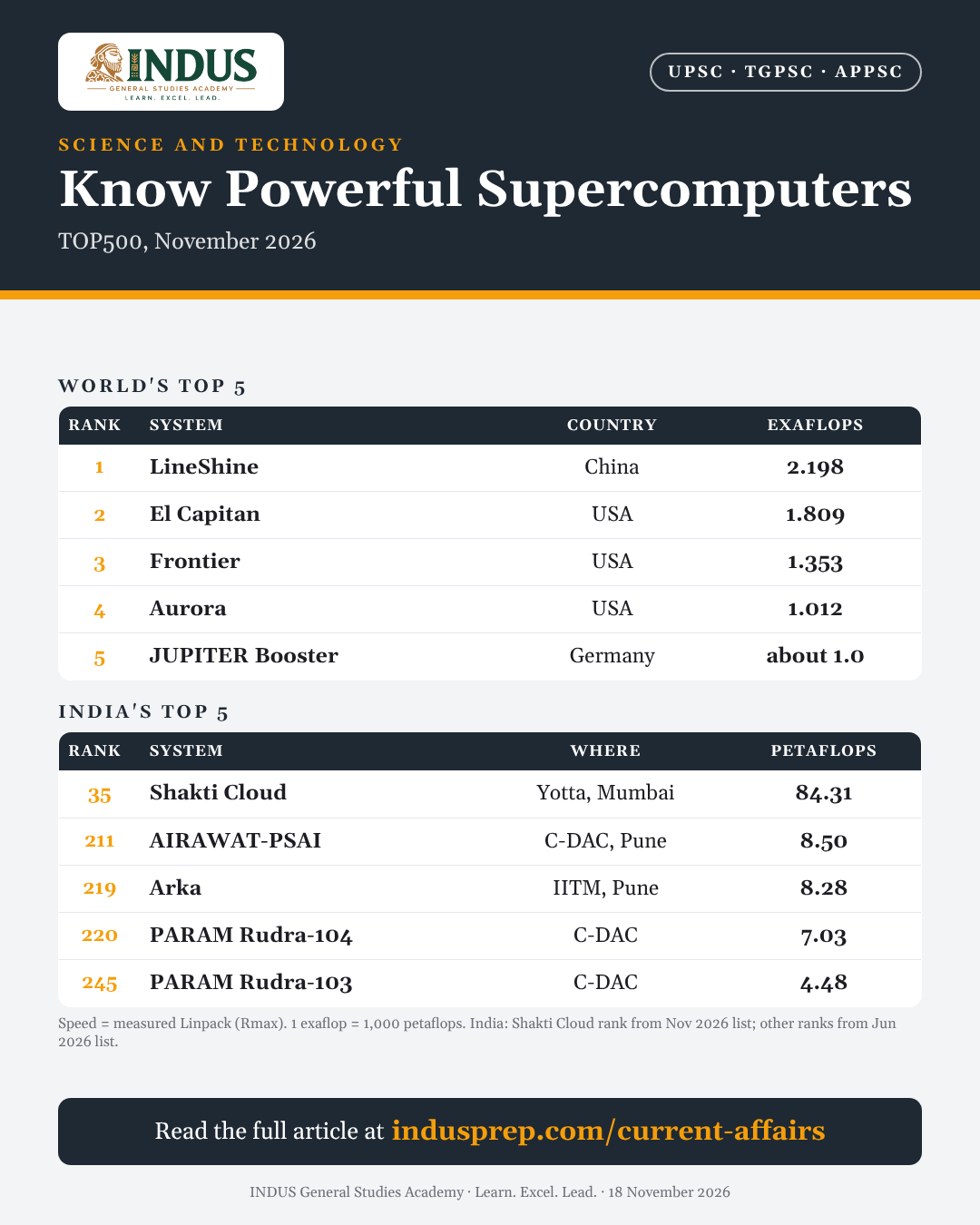
Science & Tech
India's Supercomputing Push: National Supercomputing Mission, NKN and Recent Advances
In news
- The 68th TOP500 list was released at the SC26 conference, Chicago. The top 10 are unchanged from June, and only 27 new systems entered, the fewest in the list's history.
- China's LineShine stays No. 1 at 2.198 exaflops.
- India's highest-ranked machine is Shakti Cloud (Yotta, Mumbai), at No. 35 with 84.31 petaflops.
Where India stands
- Shakti Cloud runs on Dell servers with Nvidia H100 GPUs and is a private-sector system.
- In the June 2026 list India had 7 systems, 18th among countries. The USA had 161 and China 31.
- Other Indian systems on the list: AIRAWAT-PSAI (C-DAC, Pune), Arka (IITM, Pune) and the PARAM Rudra series (C-DAC).
- The TOP500 ranks only machines that run the Linpack benchmark. India's wider national capacity is much larger than these entries.
- Speed units: 1 petaflop = 10^15 calculations per second; 1 exaflop = 1,000 petaflops.
National Supercomputing Mission (NSM)
- Launched: April 2015. Outlay: about ₹4,500 crore.
- Steered by: DST and MeitY.
- Implemented by: C-DAC, Pune and IISc, Bengaluru.
- Aim: build and deploy supercomputers in universities and research bodies across India and reduce dependence on imports.
- Build approach: three phases running together: assembly, manufacturing, and design with manufacturing support.
- Capacity (September 2026): 40 supercomputers with 68 petaflops. Of these, 13 are above 1 PF, 12 are between 500 TF and 1 PF, and 15 are below 500 TF.
- Planned: 50 supercomputers with over 123 petaflops.
- Users: over 16,000 researchers, including 2,900 PhD scholars, in 400+ institutions.
- Output: over 1.5 crore compute jobs and more than 1,990 research publications.
National Knowledge Network (NKN)
- What: India's research and education network, run by the National Informatics Centre (NIC).
- Approved: March 2010 by the Cabinet Committee on Infrastructure, with an outlay of ₹5,990 crore, as a 10-year project.
- Reach: 1,800+ institutions including universities, IITs, IIMs, research labs, libraries, healthcare and judicial institutions.
- Speed: multi-gigabit backbone with 10 Gbps links between national nodes. Institutions connect at 1 Gbps or higher.
- Link to supercomputing: NKN is the backbone that connects supercomputing facilities at academic and research institutions.
- Recent: the NKN peering agreement with Bhutan's DrukREN was renewed for three years (October 2026), and connectivity with the Maldives' higher education network is listed. A new NKN core link is due by March 2027.
Recent achievements and advances
- Rudra server: India's first indigenously designed HPC server, developed by C-DAC. About 6,000 Rudra servers are deployed in PARAM Rudra systems and 1,500 more are being made. Manufacturing technology has gone to Indian electronics manufacturing partners.
- Trinetra interconnect: indigenous network tested at 100 Gbps and 200 Gbps.
- Indigenous cooling and software: liquid cooling developed in India; a full HPC system software stack is integrated.
- PARAM Rudra: a 3 PF system was inaugurated at IIT Bombay in January 2026.
- PARAM Shivay (2019): the first NSM-built supercomputer, at IIT BHU, Varanasi.
- PARAM Shavak: a "supercomputing-in-a-box" for engineering colleges and universities.
- AIRAWAT: AI supercomputer at C-DAC Pune, with 13.17 PF peak, which entered the TOP500 at No. 75 in 2023.
- AUM processor: C-DAC is designing an indigenous HPC processor with MosChip (India) and Socionext (Japan), based on Arm Neoverse V2. A C-DAC official said indigenisation of nodes, interconnects and software has crossed 50%, and AUM was at least two years from completion (November 2025).
- Applications: flood forecasts up to two days ahead (piloted in the Mahanadi basin), forest-fire spread models (tested in the Sikkim Himalayas), weather and air-pollution models, genomics and drug discovery, seismic imaging, and applications for IMD, CWC, CPCB and AYUSH.
- NSM 2.0 is reported to target indigenous CPUs and GPUs and exascale computing.
Static connect
- PARAM 8000 (1991) by C-DAC was India's first indigenous parallel supercomputer, at 1 gigaflop. C-DAC was formed in 1988 after supercomputer import curbs.
- Pratyush (IITM, Pune) and Mihir (NCMRWF, Noida) are weather and climate supercomputers.
- Fugaku (Japan) and Frontier, Aurora, El Capitan (USA) are other leading systems.
- Exascale means 10^18 calculations a second.
Exam relevance: GS-3 (Science and Technology, Indigenisation, Computing); Prelims (NSM, C-DAC, NKN, AUM, Trinetra); TGPSC and APPSC Groups (Science and Technology, Current Affairs).
Get the full month in one PDF
The Current Affairs Monthly covers every important item in English and Telugu, with Group 1 points.
Browse current affairs material