
Mains Corner
India's Road to 1,000 GW: Can the Clean Energy Push Pass the Storage, Grid and Manufacturing Test?
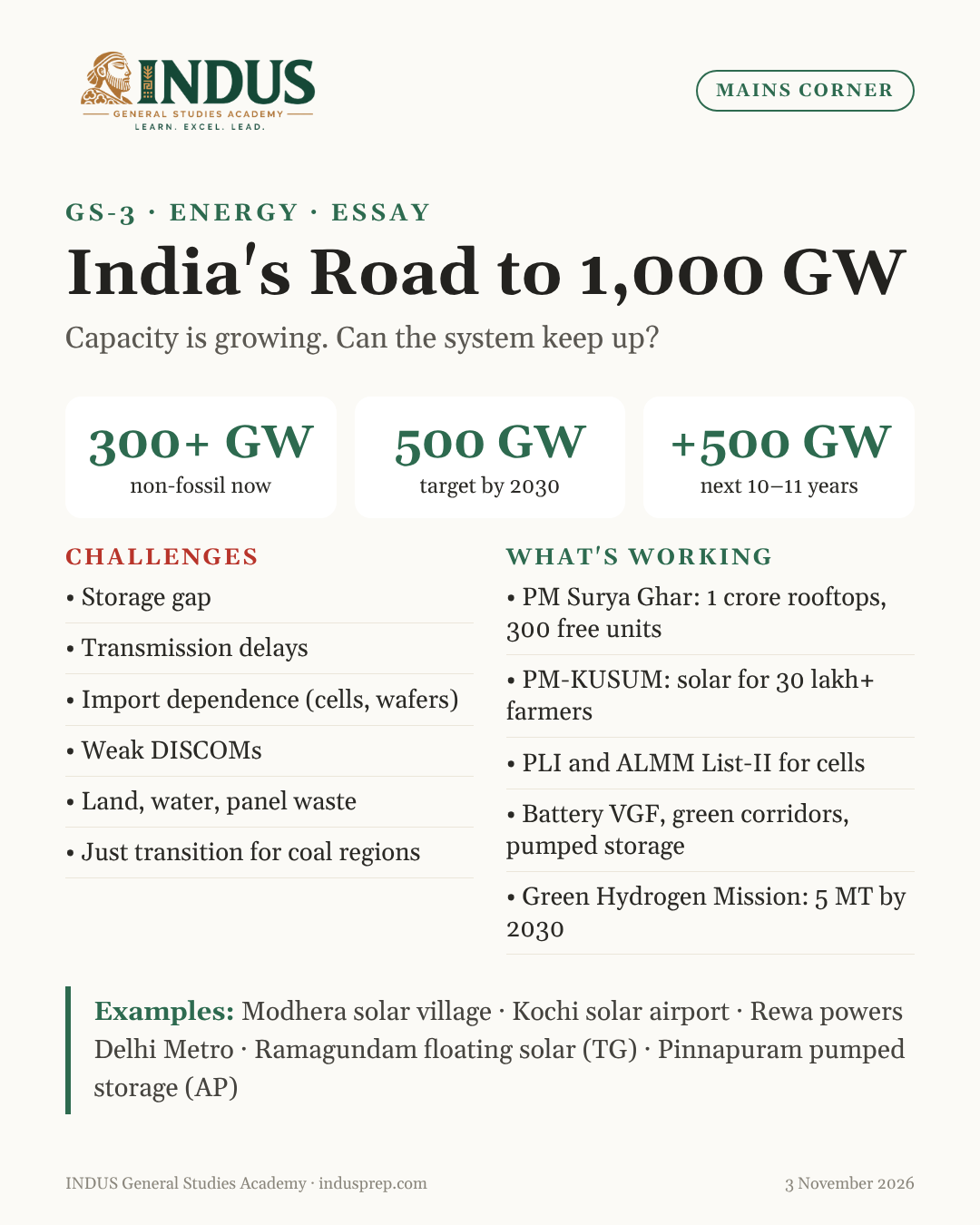
GS mapping: GS-3 (Energy, Infrastructure, Climate change) | GS-2 (International cooperation) | Essay
Why in news: At the Bharat Renewable Energy Summit 2026, the Prime Minister set a new goal: another 500 GW of non-fossil capacity in the next 10 to 11 years, beyond the 500 GW target for 2030. India also proposed a US$200 million Africa Solar Facility.
Where India stands
India's clean energy growth has been fast. The question now is whether the system around it can keep pace.
- Non-fossil capacity: crossed 300 GW in 2026, over half of India's installed power capacity.
- 50% non-fossil capacity target (NDC) met in 2025, five years early.
- Solar: grew from under 3 GW (2014) to over 170 GW.
- India has the world's third-largest renewable energy capacity.
- But: capacity is not generation. Coal still produces most of India's electricity, because solar and wind work only part of the day.
The challenges
1. Storage gap
Solar power peaks at noon. Demand peaks in the evening. Without storage, clean power is wasted by day, and coal fills the gap at night.
- The CEA estimates India needs about 236 GWh of battery storage by 2031-32.
- Installed battery storage is still a small fraction of this.
2. Transmission and curtailment
New solar and wind parks are built in Rajasthan, Gujarat and the South. Transmission lines take longer to build than solar parks.
- When lines are not ready, generated power is curtailed (wasted).
- Right of way and land disputes delay lines.
- Ecology: the Supreme Court's case on the Great Indian Bustard showed the conflict between power lines and endangered birds in Rajasthan and Gujarat.
3. Import dependence
India assembles modules but imports most of the inputs.
- Module capacity is over 200 GW, but cell capacity is only about 40 GW.
- Polysilicon and wafers come mostly from China.
- Lithium and other battery minerals are largely imported.
4. Weak DISCOM finances
- Power distribution companies carry heavy losses and debt.
- They delay payments to generators and resist rooftop solar, which cuts their sales to paying customers.
5. Land, water and waste
- Large solar parks need vast land, often in contested or ecologically sensitive areas.
- Panels need water for cleaning in dry regions.
- Solar panel waste will grow sharply as early panels retire.
6. Just transition
- Coal supports jobs and State revenues in Jharkhand, Odisha and Chhattisgarh.
- Moving away from coal needs a plan for workers and coal-dependent regions.
Best methods adopted so far
PM Surya Ghar: Muft Bijli Yojana (2024)
- Rooftop solar for 1 crore households by March 2027, with an outlay of ₹75,021 crore.
- Up to 300 units of free power a month.
- Subsidy: ₹30,000 per kW for the first 2 kW, ₹18,000 for the third kW, capped at ₹78,000.
- Over 65 lakh households have joined. A model solar village is planned in every district.
- Why it works: households become "prosumers" (both producers and consumers). It cuts bills, eases DISCOM subsidy burden and needs no new land.
PM-KUSUM
- Solar pumps and solarised agricultural feeders for farmers.
- Over 30 lakh farmers covered. It cuts diesel use and gives farmers extra income from selling surplus power.
Domestic manufacturing push
- PLI scheme for high-efficiency solar modules.
- ALMM (Approved List of Models and Manufacturers): List-I for modules; List-II for solar cells came into force in June 2026, pushing domestic cell production.
Storage and grid
- Viability Gap Funding for battery energy storage systems.
- Green Energy Corridors for renewable-rich States.
- One Nation, One Grid: all five regional grids now run on a single frequency.
- About ₹2 lakh crore planned for transmission.
- Pumped storage projects that use surplus solar power to pump water uphill.
Green hydrogen
- National Green Hydrogen Mission (2023): 5 million tonnes a year by 2030, for steel, fertilisers and refineries.
Global leadership
- International Solar Alliance (ISA), co-founded with France in 2015.
- One Sun One World One Grid and the proposed Africa Solar Facility.
Examples to use in answers
- Modhera (Gujarat): India's first round-the-clock solar-powered village.
- Kochi Airport (Kerala): the world's first fully solar-powered airport.
- Rewa Ultra Mega Solar (Madhya Pradesh): supplies power to the Delhi Metro.
- Bhadla Solar Park (Rajasthan) and Pavagada Solar Park (Karnataka): among the world's largest.
- Khavda Renewable Energy Park (Gujarat): planned as the world's largest renewable energy park.
- Omkareshwar (Madhya Pradesh): large floating solar on a reservoir.
- Ramagundam (Telangana): NTPC's floating solar plant.
- Pinnapuram, Kurnool (Andhra Pradesh): integrated renewable energy project with pumped storage.
- Diu: first Union Territory to meet its daytime power needs fully from solar.
Way forward
- Storage first: scale batteries and pumped storage; make storage mandatory with new solar tenders.
- Grid before generation: plan transmission lines ahead of solar parks.
- Full supply chain: build domestic capacity in polysilicon, wafers and cells, not just modules.
- Critical minerals: secure lithium and cobalt through overseas assets and recycling.
- DISCOM reform: smart meters, cost-reflective tariffs and timely payments.
- Distributed solar: rooftops, farm boundaries, canal tops and reservoirs to save land.
- Circular economy: recycling rules for solar panels and batteries.
- Just transition: reskilling and new industries for coal regions.
Conclusion
India has shown it can build capacity fast. The next 500 GW will depend less on new solar parks and more on storage, grids, domestic manufacturing and people's participation. Schemes like PM Surya Ghar show the way: clean energy that people own, use and benefit from.
Mains toolkit
Keywords for answers: energy security, energy transition, prosumer, curtailment, intermittency, grid integration, round-the-clock power, just transition, critical minerals, distributed renewable energy, circular economy
Practice questions
- India has met its non-fossil capacity target early, yet coal still dominates power generation. Explain the reasons and suggest measures. (150 words, 10 marks)
- "The next phase of India's energy transition will be decided by storage, transmission and manufacturing, not just capacity addition." Discuss with reference to recent initiatives. (250 words, 15 marks)
Get the full month in one PDF
The Current Affairs Monthly covers every important item in English and Telugu, with Group 1 points.
Browse current affairs material