
All current affairs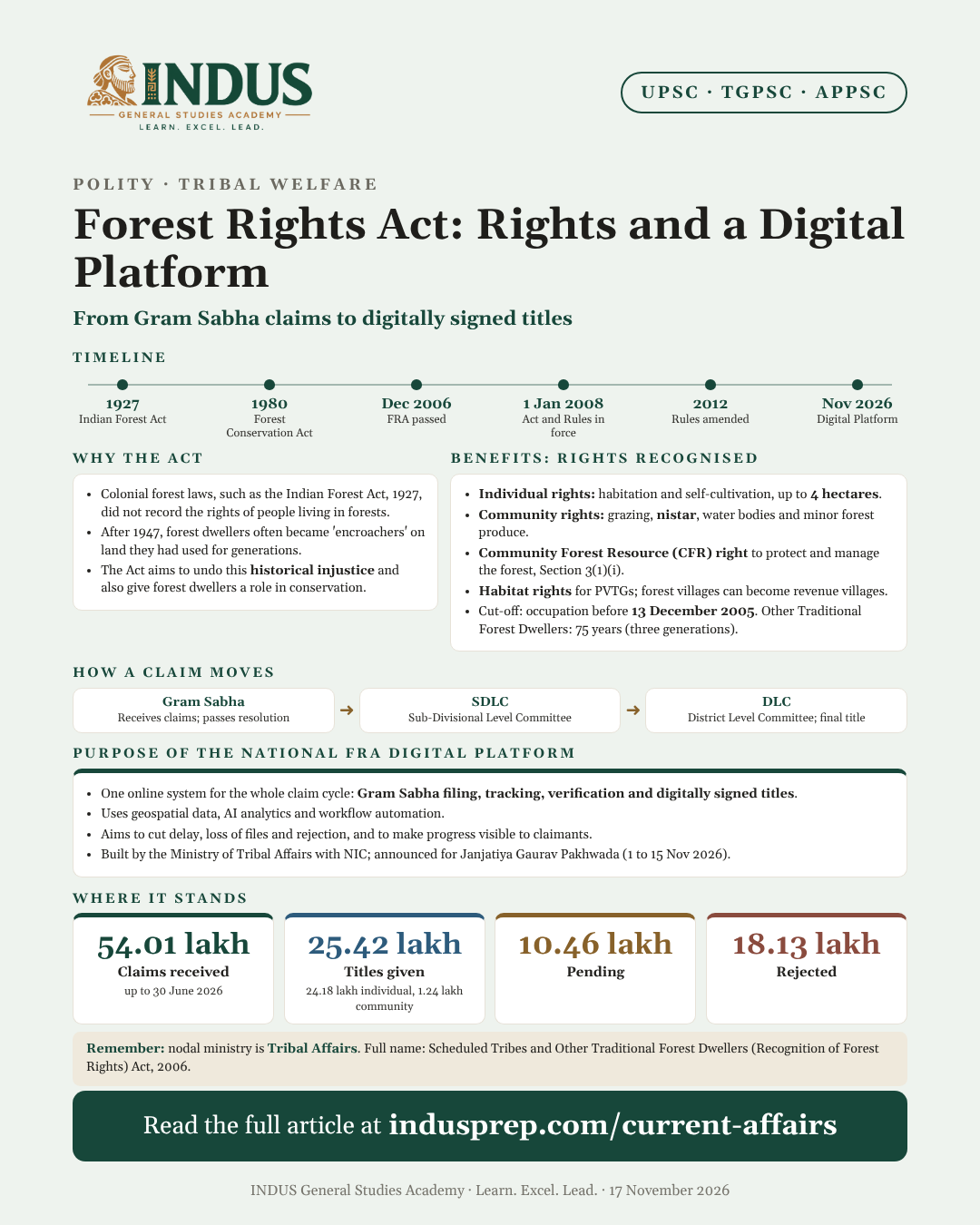
National
Forest Rights Act, 2006: 25.42 Lakh Titles and a New National Digital Platform
In news
- The Ministry of Tribal Affairs released a PIB backgrounder on the Forest Rights Act (FRA), 2006 on 16 November 2026 and reported the National FRA Digital Platform. It was announced for Janjatiya Gaurav Pakhwada (1 to 15 November 2026), which ends on Janjatiya Gaurav Diwas (15 November, Birsa Munda's birth anniversary).
- As of 30 June 2026, States reported 54.01 lakh claims. 25.42 lakh titles have been given: 24.18 lakh individual and 1.24 lakh community titles.
- About 10.46 lakh claims are pending and 18.13 lakh have been rejected.
What is the FRA?
- Full name: Scheduled Tribes and Other Traditional Forest Dwellers (Recognition of Forest Rights) Act, 2006.
- Parliament passed it in December 2006. It came into force on 1 January 2008, with the FRA Rules, 2008. The Rules were amended in 2012.
- The Ministry of Tribal Affairs is the nodal ministry. State governments implement it.
Why was it enacted?
- Colonial laws such as the Indian Forest Act, 1927 took over forests and did not record the rights of people who lived in them.
- After 1947, forest dwellers often had no papers for land and forest produce they had used for generations. Many were treated as encroachers.
- The Act says this was a historical injustice. It aims to recognise and vest forest rights, and to give communities a role in conserving forests.
What are the benefits? (rights recognised)
- Individual rights: land for habitation and self-cultivation, up to 4 hectares (Section 4(6)).
- Community rights (Section 3(1)): nistar, grazing, access to water bodies, and ownership and use of minor forest produce.
- Community Forest Resource (CFR) right (Section 3(1)(i)): the right to protect, regenerate and manage the village's traditional forest.
- Habitat rights for PVTGs (Particularly Vulnerable Tribal Groups), such as the Chenchus of Andhra Pradesh and Telangana.
- Conversion of forest villages into revenue villages, so that they can get schemes and records.
- Eligibility: Scheduled Tribes who occupied forest land before 13 December 2005. Other Traditional Forest Dwellers must show 75 years (three generations) of residence.
How is a claim decided?
- The Forest Rights Committee helps the Gram Sabha, which is the first authority. The Gram Sabha passes a resolution.
- The Sub-Divisional Level Committee (SDLC) examines it. The District Level Committee (DLC) gives the final decision and the title. A State Level Monitoring Committee reviews progress.
The National FRA Digital Platform
- Purpose: to bring the entire claim cycle into one system: filing by the Gram Sabha, tracking, verification and digitally signed titles.
- Features planned: geospatial data, AI-based analytics and workflow automation.
- Why it is needed: claims wait long between committees, and weak records lead to rejection. Some States, such as Maharashtra, already run their own FRA portals. A single national record can show claimants where their claim stands.
- Development: the Ministry worked with the National Informatics Centre (NIC) and used the Smart India Hackathon 2025. Student teams visited FRA villages in Nashik in January 2026. Final design was done at the National Tribal Research Institute, New Delhi.
- Related: FRA Cells under the Dharti Aaba Janjatiya Gram Utkarsh Abhiyan (DAJGUA, October 2024) help Gram Sabhas prepare claims. Tripura launched the Northeast's first Digital FRA Atlas in May 2026.
Concerns
- Digital divide: poor connectivity and low digital skills in tribal areas may exclude claimants.
- Gram Sabha primacy must not be reduced. The software must support the Gram Sabha, not replace it.
- High rejection (18.13 lakh rejected against 25.42 lakh titles, about two in five decided claims) needs a fair, reasoned appeal process.
- CFR titles are far fewer than individual titles. Community management of forests is the Act's main promise.
Static connect
- Niyamgiri (2013): the Supreme Court asked the Gram Sabhas of Odisha to decide on a bauxite mining project in the Dongria Kondh homeland.
- Forest (Conservation) Act, 1980 restricts diversion of forest land. FRA recognises rights on that land. PESA, 1996 gives Gram Sabhas power in Scheduled Areas.
- Fifth and Sixth Schedules protect tribal areas. Article 244 covers their administration.
- Telangana and Andhra Pradesh have large Gond, Koya and Chenchu populations. FRA titles matter for Podu land in Telangana and Scheduled Areas of AP.
Exam relevance: GS-2 (Welfare of Scheduled Tribes, Governance, Statutory mechanisms), GS-3 (Conservation); TGPSC and APPSC Groups (Polity, Society, Tribal Welfare).
Get the full month in one PDF
The Current Affairs Monthly covers every important item in English and Telugu, with Group 1 points.
Browse current affairs material