
All current affairs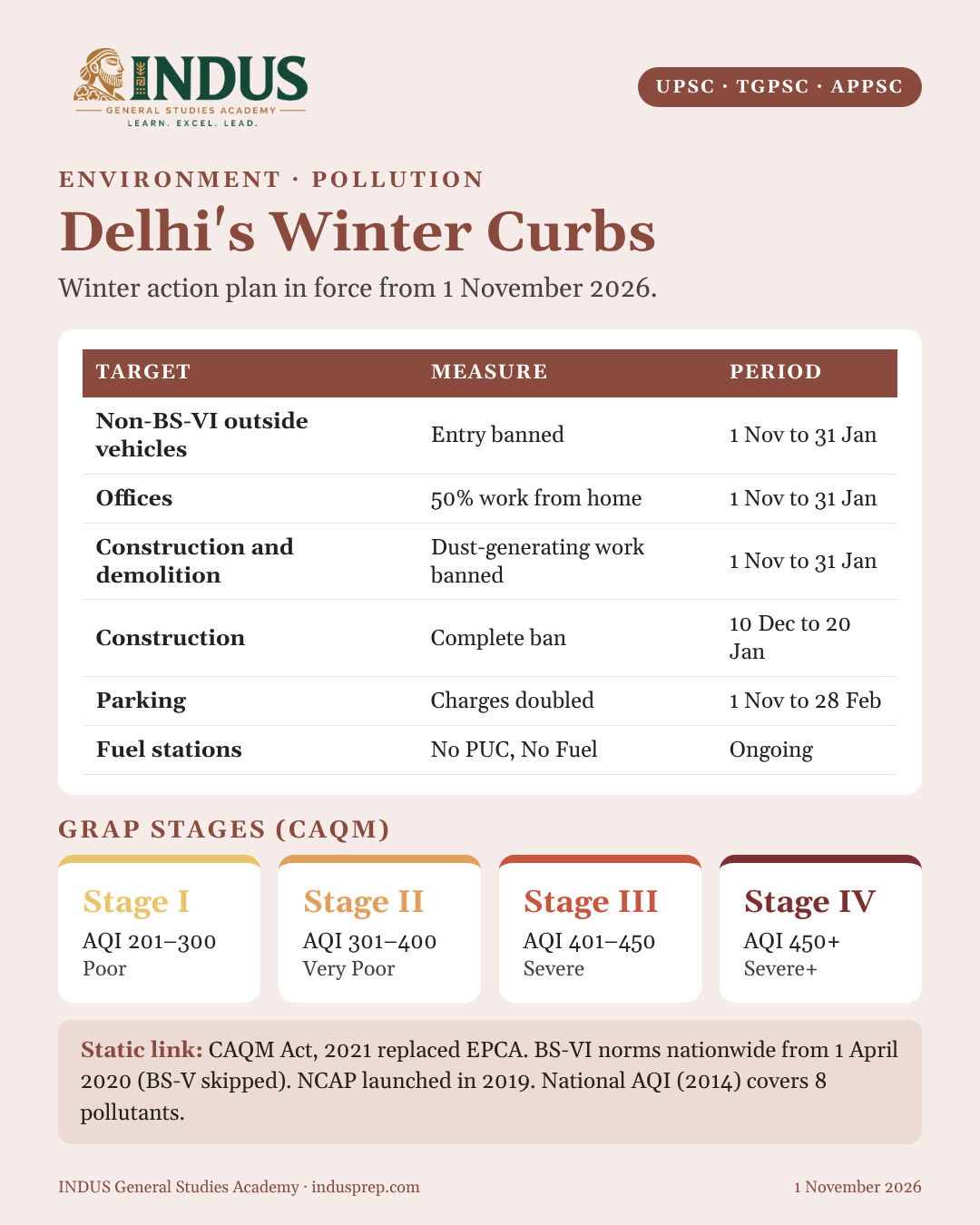
Environment
Delhi Air Pollution: Vehicle Entry Ban, 50% Work from Home from November 1
In news
- Delhi's winter action plan against air pollution came into force on 1 November 2026.
- It targets the main winter sources: vehicles, construction dust and open burning.
Key measures
| Measure | Period |
|---|---|
| Entry ban on non-BS-VI vehicles registered outside Delhi | 1 Nov 2026 to 31 Jan 2027 |
| 50% work from home in government and private offices | 1 Nov 2026 to 31 Jan 2027 |
| Ban on dust-generating construction and demolition | 1 Nov 2026 to 31 Jan 2027 |
| Complete ban on construction and demolition | 10 Dec 2026 to 20 Jan 2027 |
| Parking charges doubled (Metro parking and EVs exempt) | 1 Nov 2026 to 28 Feb 2027 |
| "No PUC, No Fuel" using ANPR cameras | Ongoing |
- Exempted: BS-VI petrol and diesel vehicles, CNG and electric vehicles, and emergency vehicles.
- Office timings are staggered to reduce peak-hour traffic.
- Through-trucks must use the Eastern and Western Peripheral Expressways.
Why Delhi's air worsens in winter
- Temperature inversion: cold air near the ground traps pollutants.
- Low wind speed: pollutants do not disperse.
- Stubble burning in Punjab and Haryana adds smoke.
- Local sources: vehicles, road dust, construction, industry and waste burning.
- Landlocked geography: the Indo-Gangetic Plain traps air between the Himalayas and the Aravallis.
Key concepts
- PM2.5 and PM10: fine particles below 2.5 and 10 micrometres. PM2.5 enters the lungs and bloodstream.
- BS-VI (Bharat Stage VI): emission norms based on Euro VI. Applied nationwide from 1 April 2020. India skipped BS-V.
- PUC certificate: proof that a vehicle meets emission limits, required under the Central Motor Vehicles Rules, 1989.
- ANPR: Automatic Number Plate Recognition cameras for enforcement.
Static connect: institutions and laws
- Commission for Air Quality Management (CAQM) in NCR and Adjoining Areas: statutory body under the CAQM Act, 2021. It replaced the EPCA.
- Graded Response Action Plan (GRAP): emergency measures in stages, based on AQI.
| GRAP stage | AQI | Category |
|---|---|---|
| Stage I | 201 to 300 | Poor |
| Stage II | 301 to 400 | Very Poor |
| Stage III | 401 to 450 | Severe |
| Stage IV | Above 450 | Severe+ |
- National Air Quality Index (2014): covers 8 pollutants.
- National Clean Air Programme (NCAP), 2019: city-wise plans to cut particulate pollution.
- Air (Prevention and Control of Pollution) Act, 1981.
- Article 21: the Supreme Court has read the right to clean air into the right to life.
Way forward
- Shift to an airshed approach, since pollution crosses State borders.
- Provide alternatives to stubble burning: Happy Seeder, bio-decomposers and ex-situ use of straw.
- Expand public transport and electric mobility.
- Strengthen State Pollution Control Boards.
- Move from seasonal emergency action to year-round source control.
Exam relevance: UPSC Prelims and GS-3 (Environment, Pollution); TGPSC, APPSC (Environment).
Get the full month in one PDF
The Current Affairs Monthly covers every important item in English and Telugu, with Group 1 points.
Browse current affairs material