
All current affairs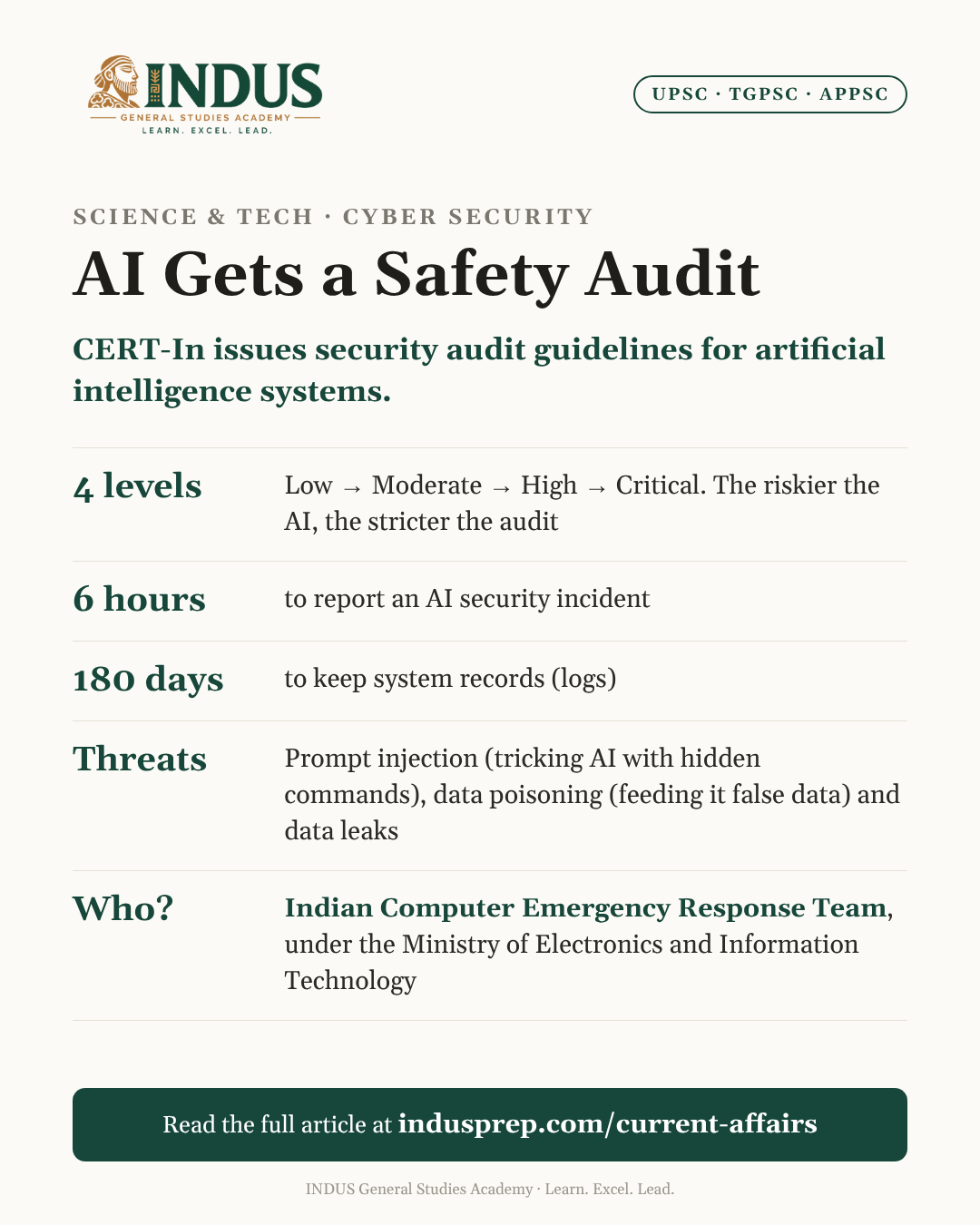
Science & Tech
CERT-In Issues AI Security Audit Guidelines: Four Risk Tiers
In news
- The Indian Computer Emergency Response Team (CERT-In) released the Artificial Intelligence Security Auditing Guidelines on 4 November 2026.
- The 107-page framework covers secure, ethical and auditable AI systems.
- It applies to AI developers and service providers whose systems handle Indian data or serve Indian users, including global AI companies.
Key features
| Item | Detail |
|---|---|
| Issued by | CERT-In, under the Ministry of Electronics and Information Technology (MeitY) |
| Nature | Not binding on AI firms; binding on CERT-In-empanelled auditors who audit AI systems |
| Approach | Risk-based: stricter audits for riskier systems |
| Coverage | Full AI lifecycle: design, data, development, deployment, monitoring, retirement |
| Incident reporting | Reportable AI security incidents within 6 hours |
| Logs | Keep system logs for 180 days |
Four risk tiers
| Tier | Audit requirement |
|---|---|
| Low | Annual review or basic internal assessment |
| Moderate | Internal audits, plus an independent audit at least once a year |
| High | Independent third-party audit, up to every six months |
| Critical | Independent audit with continuous monitoring |
- Tier depends on: harm if the system fails, level of autonomy, sensitivity of data, scale of use, whether harm can be reversed, and importance to essential services.
Areas audited
- AI governance
- Data quality and privacy
- Model risk management
- Fairness (no bias)
- Transparency (explainable decisions)
- Cybersecurity
- Continuous monitoring
- Human oversight
- Third-party suppliers
AI-specific threats named
- Prompt injection: hidden instructions trick the AI into wrong actions.
- Data poisoning: corrupt training data makes the model behave wrongly.
- Leakage of sensitive data.
- Excessive permissions given to AI agents.
- Unsafe communication between multiple AI agents.
- Compromised models and insecure software components.
- Extra checks for generative AI, chatbots, AI agents, multimodal AI and autonomous systems.
Why it matters
- AI is now used in banking, health, policing and public services. Failures can harm many people at once.
- Common standards make AI in India more accountable.
- Builds trust for wider AI adoption under the IndiaAI Mission.
India vs European Union approach
| India (CERT-In guidelines) | European Union (AI Act, 2024) |
|---|---|
| Audit guidelines; not a law | Binding law with penalties |
| Four tiers: low, moderate, high, critical | Four tiers: unacceptable (banned), high, limited, minimal |
| Light-touch; promotes innovation | Strict compliance before market entry |
Concerns
- Voluntary for firms: they apply only when an audit is done.
- Shortage of skilled AI auditors.
- Compliance cost for startups.
- Overlap with the Digital Personal Data Protection Act, 2023.
Static connect
- CERT-In: national nodal agency for cyber incidents; set up in 2004; statutory role under Section 70B, Information Technology Act, 2000.
- CERT-In Directions (April 2022): 6-hour reporting of cyber incidents and 180-day log retention. The new guidelines carry these over to AI.
- IndiaAI Mission (2024): ₹10,371.92 crore for AI computing, datasets, skills and safe AI.
- IndiaAI Safety Institute (2025): works on safe and trusted AI.
- India AI Governance Guidelines (2025): principle-based, light-touch governance of AI.
Exam relevance: UPSC Prelims and GS-3 (Science and Technology, Cyber security), GS-2 (Governance); TGPSC, APPSC (Science and Technology).
Get the full month in one PDF
The Current Affairs Monthly covers every important item in English and Telugu, with Group 1 points.
Browse current affairs material