
All current affairs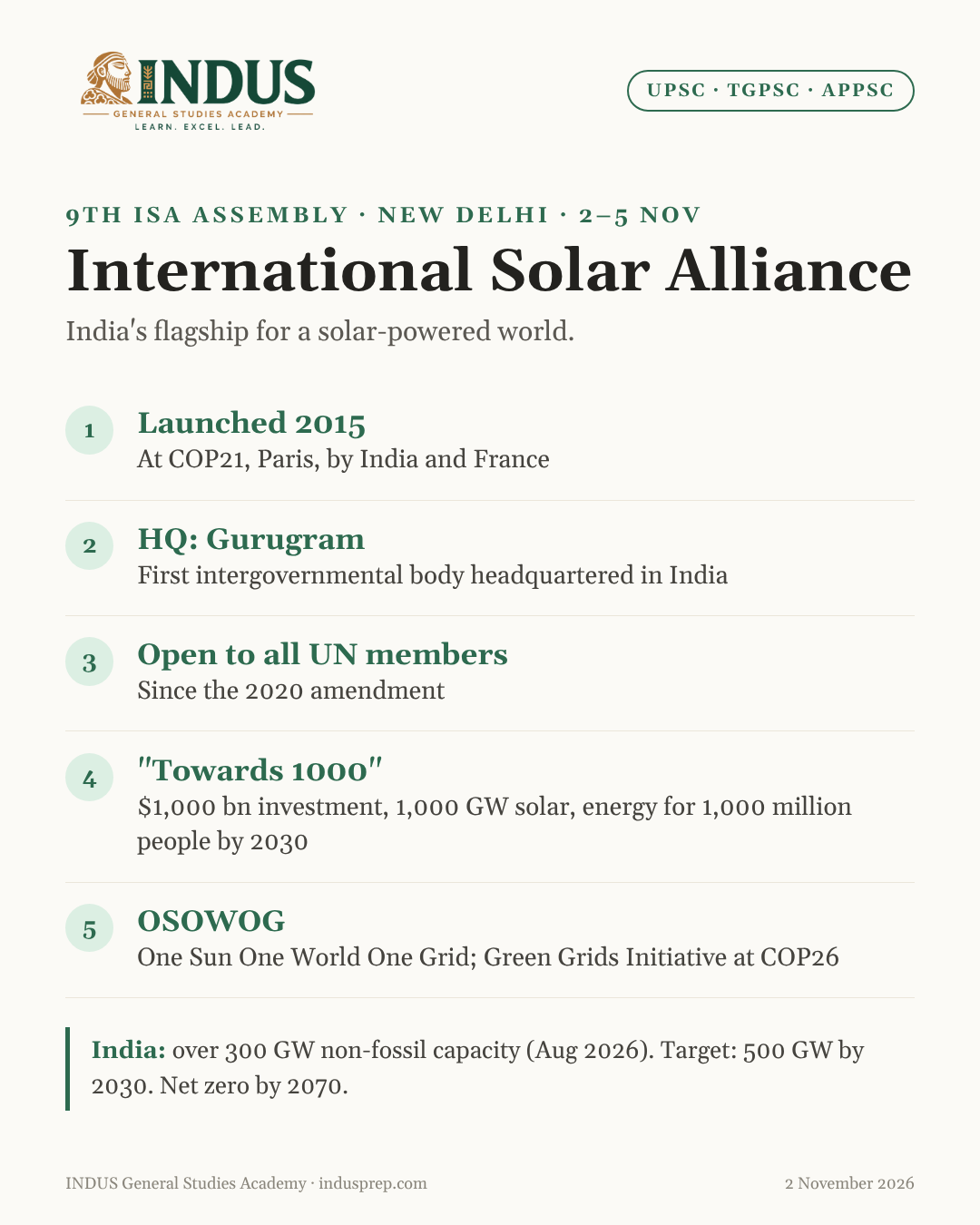
International
9th ISA Assembly and Bharat RE Summit: India's Push for a Solar-Powered World
---ARTICLE---
In news
- The 9th Session of the International Solar Alliance (ISA) Assembly is being held at Bharat Mandapam, New Delhi, from 2 to 5 November 2026.
- It is held together with the Bharat Renewable Energy (BRE) Summit and Expo 2026 and the 4th International Conference on Green Hydrogen (ICGH).
- This is the first time the three events share one platform.
Key facts
| Item | Detail |
|---|---|
| Venue | Bharat Mandapam, New Delhi |
| Scale | 75+ countries, 500+ speakers, 400+ exhibitors |
| Focus areas | Solar markets, green hydrogen, distributed RE, clean energy manufacturing, green finance, AI in energy |
| Organiser | Ministry of New and Renewable Energy (MNRE), with ISA |
About the International Solar Alliance
- Launched: 30 November 2015, at COP21 in Paris, by India and France.
- Legal status: a treaty-based intergovernmental organisation. Its Framework Agreement entered into force on 6 December 2017.
- Headquarters: Gurugram, Haryana, on the National Institute of Solar Energy campus. It is the first international intergovernmental body headquartered in India.
- Membership: first meant for solar-rich countries between the Tropics. A 2020 amendment opened it to all UN member countries.
- Members: over 120 member and signatory countries.
- Observer status at the UN General Assembly.
- Assembly: the apex decision-making body. India is the President and France the Co-President.
Major ISA initiatives
- "Towards 1000" strategy: mobilise US$1,000 billion of solar investment, provide energy access to 1,000 million people and install 1,000 GW of solar capacity by 2030.
- One Sun One World One Grid (OSOWOG): a vision of a global interconnected solar grid. Its first step, the Green Grids Initiative, was launched with the UK at COP26 (2021).
- Global Solar Facility: a fund to attract investment into solar projects in underserved regions, mainly Africa.
- STAR-C: a network of Solar Technology Application Resource Centres for skills and training.
- SolarX Startup Challenge: support for solar startups.
India's renewable energy progress
- India's non-fossil power capacity crossed 300 GW in August 2026.
- Non-fossil sources now form over half of India's installed power capacity.
- India met its NDC target of 50% non-fossil installed capacity in 2025, five years before 2030.
- India has the world's third-largest renewable energy capacity.
- Target: 500 GW of non-fossil capacity by 2030.
Key schemes
- PM Surya Ghar: Muft Bijli Yojana (2024): rooftop solar for 1 crore households, with up to 300 units of free power a month.
- National Green Hydrogen Mission (2023): target of 5 million tonnes of green hydrogen a year by 2030.
- PLI for high-efficiency solar PV modules: to build domestic manufacturing.
- PM-KUSUM: solar pumps and solar plants for farmers.
- Solar parks and Green Energy Corridors for transmission.
Why it matters
- Energy security: less dependence on imported oil and gas.
- Climate action: supports India's net zero by 2070 goal and the Panchamrit pledges of COP26.
- Global South leadership: ISA gives developing countries a voice in clean energy finance and technology.
- Soft power: ISA is a flagship of Indian climate diplomacy, along with CDRI and Mission LiFE.
- Jobs and manufacturing: solar, batteries and green hydrogen are new growth sectors.
Challenges
- Import dependence: India relies heavily on China for solar cells, wafers and polysilicon.
- Storage gap: solar power is intermittent. Battery and pumped storage capacity is still low.
- Transmission: grid lines and land acquisition lag behind new solar capacity.
- Finance: high cost of capital in developing countries.
- DISCOM health: financially weak power distribution companies delay payments.
- ISA's own limits: pledges outpace actual investment on the ground.
Static connect
- COP26 Panchamrit (2021): 500 GW non-fossil capacity by 2030; 50% of energy needs from renewables by 2030; cut 1 billion tonnes of emissions by 2030; reduce emissions intensity of GDP by 45% from 2005 levels; net zero by 2070.
- CDRI (Coalition for Disaster Resilient Infrastructure): launched by India in 2019.
- Global Biofuels Alliance: launched during India's G20 Presidency (2023).
- IRENA: the International Renewable Energy Agency, headquartered in Abu Dhabi.
Way forward
- Build a full domestic solar supply chain, from polysilicon to modules.
- Scale up battery energy storage and pumped hydro.
- Speed up transmission and green energy corridors.
- Use ISA to channel affordable finance to Africa and small island States.
- Push green hydrogen for hard-to-abate sectors such as steel and fertilisers.
Exam relevance: UPSC Prelims, GS-2 (International institutions) and GS-3 (Energy, Climate change); TGPSC, APPSC (Science and Technology, Environment).
Get the full month in one PDF
The Current Affairs Monthly covers every important item in English and Telugu, with Group 1 points.
Browse current affairs material