
All current affairs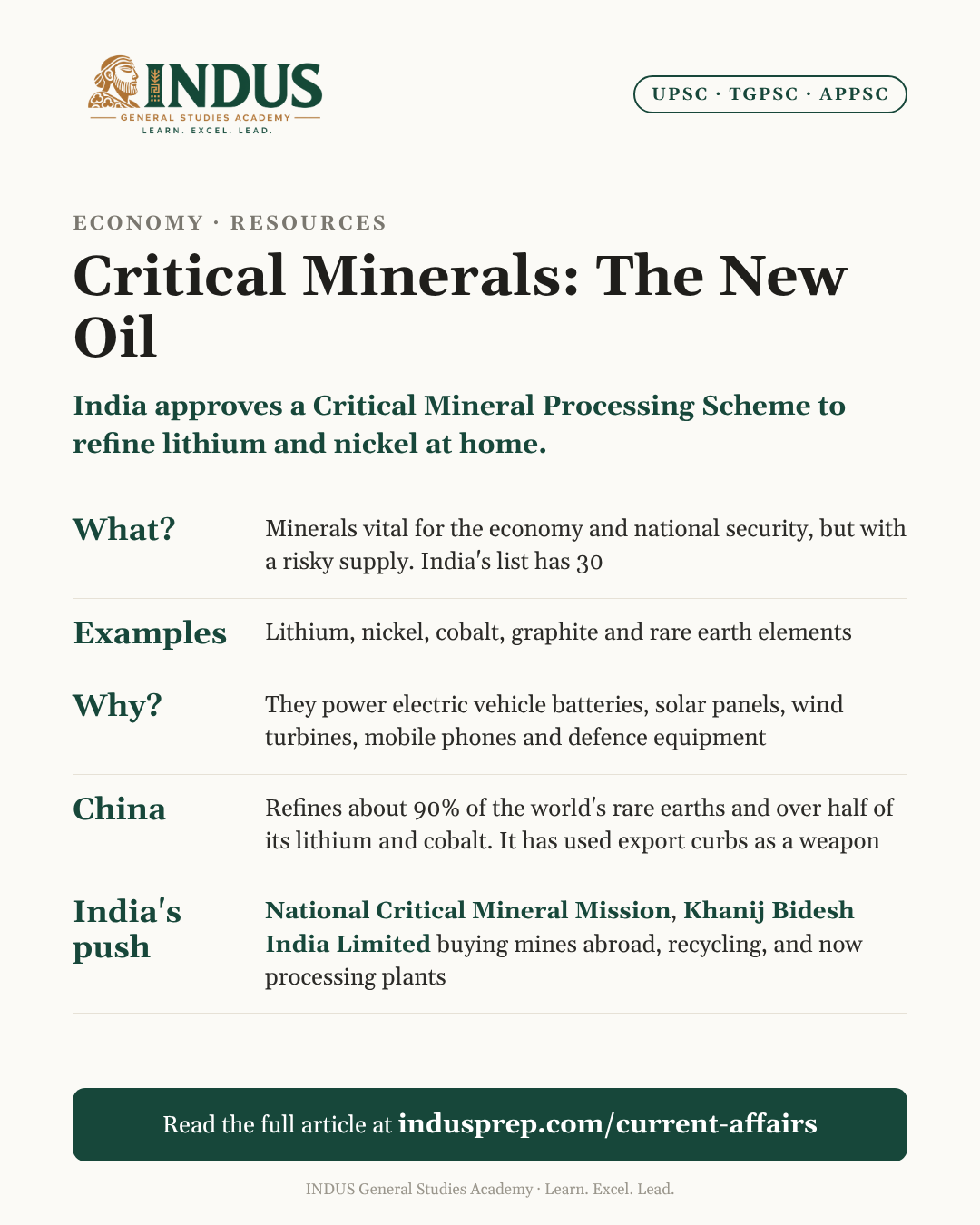
Economy
₹2,814 Crore Scheme to Process Lithium and Nickel in India
In news
- The Union Cabinet (4 November 2026) approved the Capex Support Scheme to Promote Critical Mineral Processing.
- Outlay: ₹2,814 crore. Period: 2026-27 to 2030-31.
- Aim: turn lithium and nickel ores into high-purity compounds within India.
Key facts
| Item | Detail |
|---|---|
| Outlay | ₹2,814 crore (lithium: ₹1,000 crore; nickel: ₹1,800 crore) |
| Support | 30% capital subsidy on eligible investment |
| Plants | 4: two lithium, two nickel |
| Cap per plant | ₹500 crore (lithium); ₹900 crore (nickel) |
| Minimum capacity | 30 kilotonnes (lithium); 50 kilotonnes (nickel) |
| Selection | Two stages: technical qualification, then bidding on lowest subsidy sought |
| Release | Three instalments, linked to milestones |
| By-product | Cobalt recovered from nickel processing |
Why processing matters
- Mining is only the first step. Ore must be refined into battery-grade chemicals.
- India imports most of these refined intermediates and high-purity materials.
- China dominates processing: it refines about 90% of rare earths and well over half of the world's lithium and cobalt.
- China has used export controls on gallium, germanium and rare earths since 2023. This exposed the risk of depending on one country.
- India's nickel demand is set to double, from about 50 kilotonnes (2025) to 100 kilotonnes (2030).
Uses
- Lithium, nickel and cobalt: cathodes of lithium-ion batteries for electric vehicles and energy storage.
- Nickel: also used in stainless steel and special alloys.
- Target sectors: electric mobility, battery storage, defence, electronics, special steel.
Link to energy storage
- On the same day, the Cabinet cleared a ₹14,500 crore scheme for 92 GWh of energy storage.
- Battery storage needs lithium and nickel. Domestic processing supports the 40% domestic content rule for battery projects.
India's critical minerals journey
- 2019: KABIL (Khanij Bidesh India Ltd) set up to secure minerals abroad; a joint venture of NALCO, Hindustan Copper and MECL. It has lithium blocks in Argentina.
- 2023: list of 30 critical minerals released by the Ministry of Mines.
- 2023: MMDR Amendment Act let the Centre auction critical minerals and opened exploration to private firms.
- 2023: 5.9 million tonnes of inferred lithium resources reported in Reasi, Jammu and Kashmir.
- 2023: India joined the US-led Minerals Security Partnership.
- 2025: National Critical Mineral Mission: ₹16,300 crore, plus ₹18,000 crore from public sector companies.
- 2025: ₹1,500 crore scheme for recycling critical minerals from e-waste and old batteries.
- 2025: ₹7,280 crore scheme for rare earth permanent magnets.
Challenges
- Processing is energy-intensive and needs advanced technology, which India lacks at scale.
- Domestic ore is limited, so plants may depend on imported ore.
- Pollution and waste from chemical refining need strict control.
- Long gestation; global prices of lithium and nickel are volatile.
Static connect
- Critical minerals: minerals essential for the economy and national security, whose supply is at risk (few sources, high import dependence).
- Examples: lithium, cobalt, nickel, graphite, rare earth elements, gallium, germanium, tungsten.
- Mines and Minerals (Development and Regulation) Act, 1957: the main law on mining; amended in 2015, 2021 and 2023.
Exam relevance: UPSC Prelims and GS-3 (Economy, Mineral resources, Industry), GS-2 (International relations); TGPSC, APPSC (Economy, Geography).
Get the full month in one PDF
The Current Affairs Monthly covers every important item in English and Telugu, with Group 1 points.
Browse current affairs material